
Care sector could save billions: Productivity Commission
The Productivity Commission warned: "Without decisive action, future generations will face deeper health inequities and a care system increasingly unable to meet their needs."


The Productivity Commission (PC) released its final productivity inquiry reports on 19 December last year, including a report on ‘Delivering quality care more efficiently’.
The PC has made 37 recommendations to improve efficiency across the economy, including three related to care.
“Governments can lift productivity by breaking through the siloed approach to decision-making in the care economy, and improving the quality and efficiency of the services it provides,” said PC Chair Danielle Wood.

The PC inquiry
In 2024, the Federal Government identified five key areas it could reform to improve productivity, including care. Productivity, the key driver of wages growth and living standards, fell to its lowest level in 60 years in 2020.
The Government asked the PC to identify which productivity improvements should be prioritised. The PC published interim reports mid-last year with preliminary recommendations, and then in December, published its final reports with advice about reforms, feasibility and risks.
The PC's final care report is based on their consultations with 82 care organisations, three roundtables, 96 questionnaire responses, and 257 submissions conducted in the second half of last year.
“Decisive action” needed
The PC’s final report on care warns Australia will “face deeper health inequities and a care system increasingly unable to meet their needs” if it does not take “decisive action”.
The PC has identified three areas for reform of the care economy:
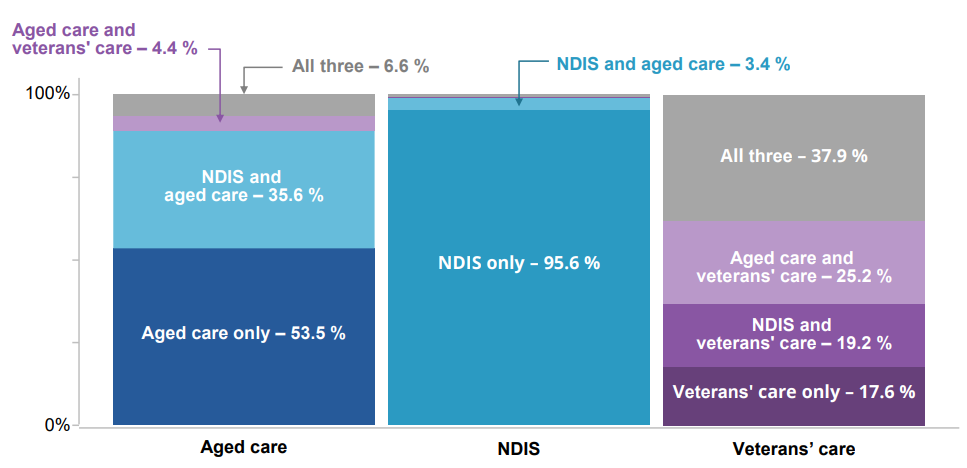
- Recognising there are strong similarities between aged care, the NDIS and veteran’s care, the PC believes there are opportunities to align worker regulation and quality and safety regulation with a single regulator.
Reducing duplicated paperwork alone would save providers and workers an estimated $1.8 billion over 10 years, the equivalent of more than 21 million care hours, the PC estimates.
- The PC’s second recommendation is for the Government to embrace ‘collaborative commissioning’, where organisations work together to plan, procure and evaluate services for their communities.
An example of ‘collective commissioning’ is Not For Profit aged care provider Whiddon’s pilot of six programs rolled out in partnership with 20 organisations.
Governments should support collaboration between Local Hospital Networks, Primary Health Networks, Aboriginal Community Controlled Health Organisations, and other organisations, with additional funding, the PC recommends.
Increased collaborative commissioning could reduce preventable hospitalisations by 5% and emergency department presentations by 4%, saving about $600 million annually, the PC forecasts – or $6 billion over 10 years.
- The PC also recommends the Government invests more in prevention and early intervention.
Investing $1.5 billion over the first five years of a proposed National Prevention Investment Framework could return savings to Government of around $2.7 billion 10 years after the initial investment, the PC estimates.
When broader health, social and economic benefits are included, the value of total benefits would be about $5.4 billion.
Changes already underway
The report notes the Government has already taken steps towards greater regulatory alignment with the shifting of disability policy into the Department of Health, Disability and Ageing after last year’s Federal election.
Implementation of the Aged Care Act 2024 also means provider registration is now more aligned with NDIS requirements.
And worker registration and screening reforms are also underway, providing opportunities for them to become more aligned
Timeframe
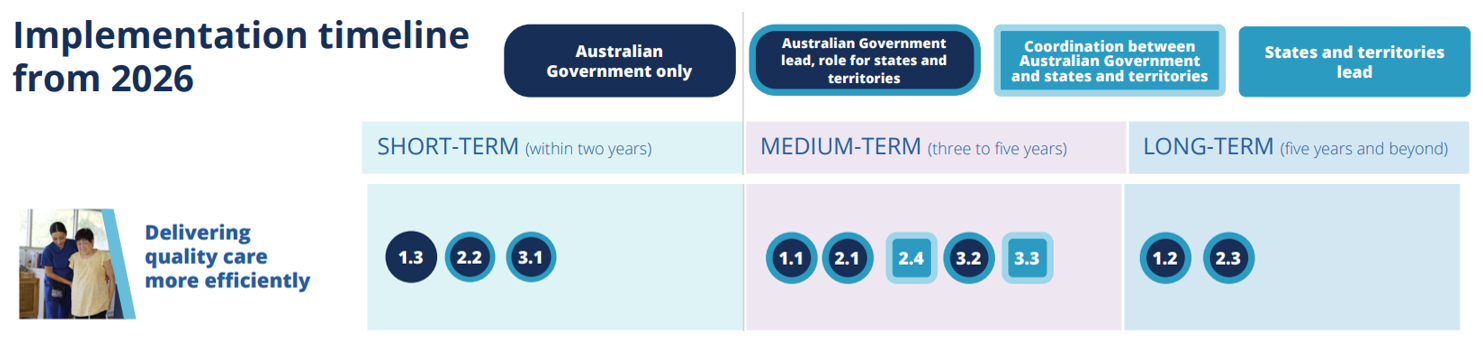
The PC recommends some changes can be made within two years, such as aligning worker regulation between aged care, the NDIS and veteran’s care, appointing a minister to drive align regulation in the care economy, and establishing agencies to lead changes. Other reforms could be rolled out over 10 years.
Read the PC's Care Sector Inquiry Report in full here.


