
Colliers: Land lease planning bottlenecks threaten housing targets


Australia will not meet its housing targets unless it fixes how – and where – it builds for older Australians, according to a new report.
Fresh research released by Colliers, in partnership with UDIA NSW, shows households aged 50 and over will drive 75% of new dwelling demand over the next two decades – requiring an estimated 2.27 million homes by 2044.
But the problem isn’t demand – it’s delivery.
The 41-page ‘Why LLCs Matter in Today’s Housing Landscape’ report finds that planning systems – particularly in NSW and Victoria – are constraining the supply of age-appropriate housing at precisely the moment the system needs it to scale.
The report’s author Lynn Johnsen, Head of Data Solutions for Healthcare & Retirement Living at Colliers, said the findings expose a fundamental mismatch between demographics and supply.

“Australia’s housing challenge is increasingly an age-appropriate supply challenge that cannot be solved without aligning supply with demographic reality,” she said.
Land lease: fast, scalable – and stuck
The research – endorsed by UDIA NSW’s Land Lease Working Group – identifies Land Lease Communities (LLCs) as one of the most under-utilised housing solutions available.
The findings note that LLCs typically deliver homes priced at 60-80% of local median values, can be built up to 50% faster than traditional housing, and allow older Australians to downsize without debt – freeing up family homes back into the broader market.
Yet despite these advantages, LLC delivery remains constrained.
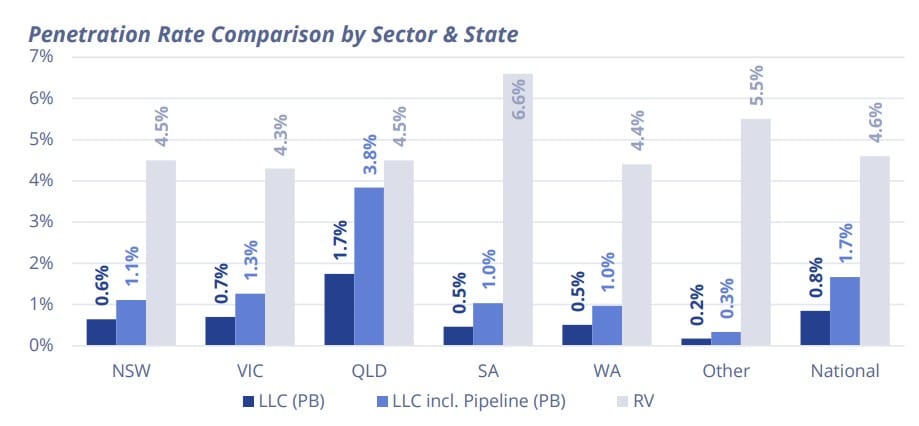
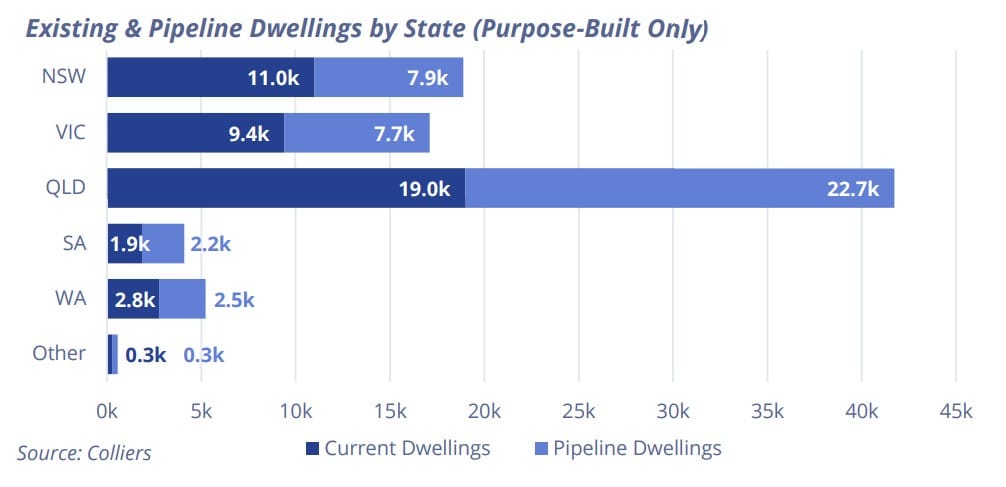
Australia currently has around 44,000 ‘purpose-built’ land lease dwellings, with a further 43,000 in the national pipeline (see penetration rate data below). Colliers estimates that falls well short of what’s needed, pointing to a requirement for around 200,000 additional dwellings over the next 20 years.
Kate Melrose, Chair of the UDIA NSW Land Lease Communities Committee, said the sector’s potential is being held back by outdated policy settings rather than market fundamentals.

“Land lease is one of the most powerful and under-utilised solutions in Australia’s housing continuum,” she said. “It offers affordability without sacrificing quality, gives older Australians control and flexibility, and can be delivered quickly and reliably when planning frameworks are clear.”
The NSW-VIC gap
The mismatch is most acute in NSW and Victoria.
Together, the two states are expected to generate 60% of future demand, but account for just 36% of the current pipeline – a shortfall that the report links directly to inconsistent planning frameworks, unclear definitions and slow approvals.

Queensland tells a different story. With clearer planning pathways, it now accounts for 47% of existing supply and 57% of national greenfield developments, demonstrating how policy settings – not capital appetite – are shaping where land lease housing actually gets built.
Regional leads – but metro pressure is coming
Regional areas are currently the mainstay of the sector, accounting for 59% of existing supply and 73% of planned developments.
But while this is supporting regional economies and absorbing population growth, the report warns that without reform, metropolitan and peri-urban demand will continue to outpace supply.
The warning
The report concludes that Australia’s housing challenge is now inseparable from its ageing profile.
Without clearer planning pathways and regulatory reform – particularly in high-demand states – land lease housing will remain a bottleneck in the national supply chain.
In short, the demographics are locked in. Whether the homes get built is now a decision for Governments and regulators.
The UDIA will now utilise the research to advocate to key decision makers, State Governments and Councils for greater planning and certification pathways for the land lease sector.
Download the paper here.


