
FTI sets out seven-point plan to unblock hospital gridlock


Australia’s hospital congestion crisis cannot be solved by aged care alone – and it cannot be solved by hospitals acting in isolation.
That is the central message of the third and final instalment of FTI Consulting’s Unlocking Capacity series, released on Tuesday (24 February), which has moved from outlining the challenges around delayed discharge to setting out a practical roadmap for reform.
The 21-page report, A Path Forward, argues that Australia must adopt a “whole-of-system capacity lens” – recognising that hospital flow depends not just on aged care supply, but also on workforce settings, funding design, discharge processes, housing barriers and cross-Government coordination.
“Unlocking capacity across our hospitals and aged care sectors is complex, but it is not impossible,” said Nicki Doyle, Head of FTI Consulting Aged Care, Australia.

But this is not simply a policy problem for Canberra, Nicki told The Weekly SOURCE.
“It’s not just a health issue,” she said. “State Governments need to look across their departments – not only health – and think about how their systems interact.”
Seven domains for reform
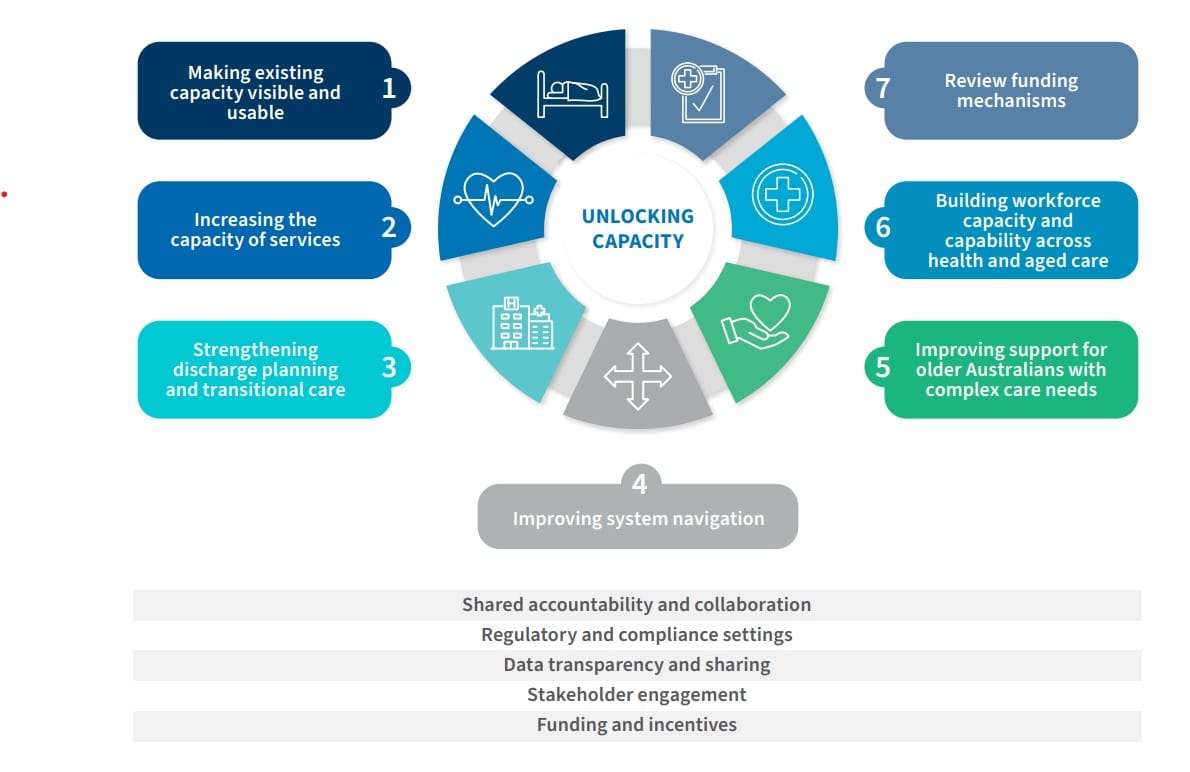
FTI identifies seven solution areas to relieve immediate pressure on the health and aged care system and improve long-term sustainability:
- Establishing a national “single source of truth” for bed capacity data across hospitals and aged care.
- Increasing residential aged care supply – with an estimated 10,600 new beds required annually – through concessional finance, modular builds and repurposing under-utilised assets.
- Starting discharge planning at hospital admission and expanding step-down models such as Time to Think and Transition Care.
- Expanding aged care navigator roles within hospitals and moving toward seven-day discharge support.
- Improving hospital-to-aged-care clinical integration for dementia and complex care patients.
- Building workforce capability, including rotational roles across hospital, residential and community settings.
- Introducing dedicated bilateral aged care funding agreements between Commonwealth and states to allow pooled, flexible discharge funding.
The final report follows two earlier instalments, which found that Australians aged 65 and over now account for 44% of hospitalisations and 52% of patient days – and are almost three times more likely to become long-stay patients.
Beyond Government: an opportunity for providers
While the report calls for funding and governance reform, Nicki said providers also have a role to play in the solution.
“There is opportunity here,” she said. “Providers should be thinking about whether there is a business opportunity – whether they can work locally with their health services to come up with different solutions.”
That may include transitional models, local discharge partnerships or innovative service designs tailored to regional hospital pressures.
Nicki said providers with strong local relationships are better positioned to respond.
“The more we operate in separate compartments, the less aged care understands what health needs – and the less health understands what aged care needs,” she said. “We can’t remain separate.”
Lessons from COVID – but permanent this time
Nathan Schlesinger, Head of FTI Consulting Health, Australia, said the COVID-19 pandemic demonstrated that cross-sector coordination is possible when urgency demands it.

“The lessons learned during COVID must now translate into permanent arrangements,” he said.
While the recently signed National Health Reform Agreement signals Federal and State and Territory Governments have recognised the scale of the issue, FTI argues small-scale reform will not be enough.
Significant new investment in aged care infrastructure and workforce will be required to prevent rising hospital congestion as the 85-plus population grows rapidly over the coming decade.
The series concludes that practical solutions exist – but without whole-of-Government buy-in and stronger local collaboration between hospitals and providers, discharge bottlenecks will only worsen.
You can download the full Unlocking Capacity series via FTI Consulting’s website.


