
HELF: the aged care fee was always going to explode


Providers have been told to stop cross-subsidising care. This week’s backlash shows what happens when policy lands without explanation.
This week’s Higher Everyday Living Fee (HELF) blow-up was entirely predictable.
At StewartBrown’s Finance Forum last October, Pride Living’s James Saunders walked the audience through the Higher Everyday Living Fee and our reaction was immediate: this new system would end up on the front page – now it has.
What has unfolded is not really a scandal about ice-cream, hot breakfasts or televisions. It is a collision between Government policy and community perceptions – and the sector has been caught in the middle.
Aged care providers have been told, repeatedly, that they cannot make a margin on care.
Mark Butler has said it. IHACPA has reinforced it and now the new Aged Care Act has embedded it in the system.
If not care, then where?
If care must be delivered at zero margin, then the business has to work somewhere else.
That is why the new Act introduced levers such as increased consumer contributions, RAD retention and HELF. They are not optional extras – they are part of the financial model designed to keep providers viable.
Yet almost none of that has been explained properly to the public.
So when HELF hits the headlines, it lands as if providers have invented a new fee to gouge residents – rather than implementing a framework designed by the Department itself.
That is why the sector now finds itself in an impossible position.
If providers continue absorbing the cost of lifestyle and hotel-style services, they undermine their sustainability.
But if they charge transparently for those services, they risk public backlash and political criticism.
Damned if you do, damned if you don’t.
The optics problem
The optics, of course, are terrible.
The image of an older person being charged extra for a television is an easy target. But the real question is bigger than what sits on the minimum service list.
It is this: does the Government want taxpayers funding every discretionary extra in aged care – at a time when many Australians are struggling with everyday living costs?
Or does it want a user pays model where residents who want more can choose more?
Because the new Act is meant to be about consumer choice – and yet the sector and Government have not really explained what that means in practice.
A sector holding back
Mirus’ latest poll, released this week, captures the concern among operators. Of 240 aged care professionals across 137 organisations, 49% say they have not yet implemented a HELF model. See below.
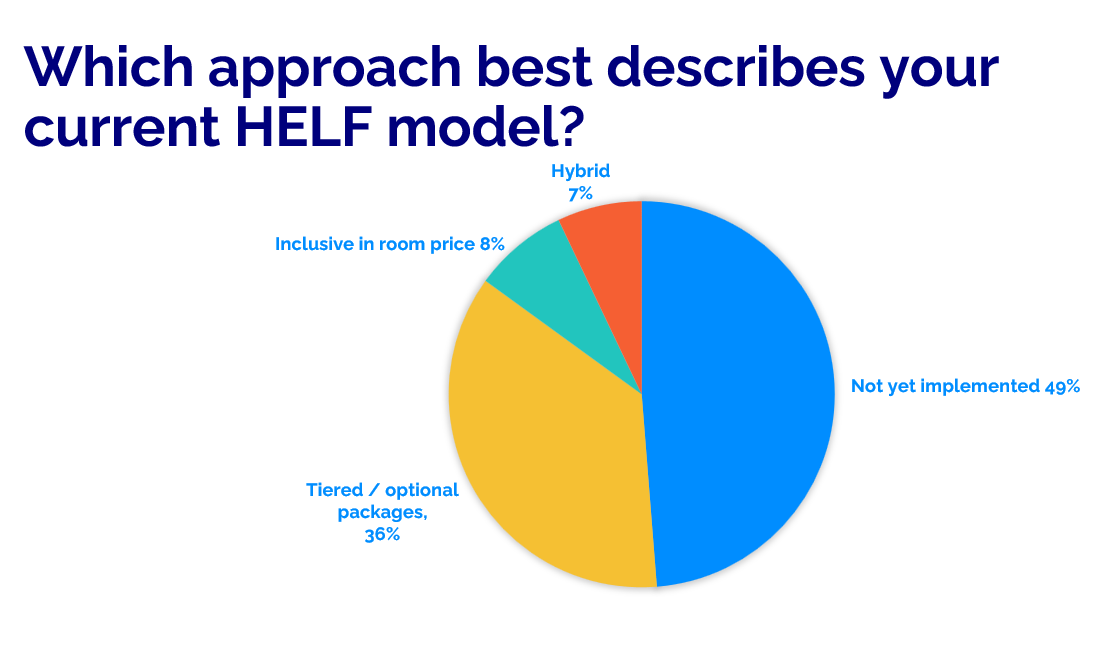
Only 8% say room prices fully recover capital and operating costs, while 42% cite operational complexity as their biggest concern.
Operators know the old financial model is broken. But many are reluctant to move – because they have seen exactly what happens when they do.
This is where both Government and the sector have fallen short.
Government has not made a convincing public case for why these changes are necessary. And too many providers still struggle to explain the true cost of delivering aged care services – or the business logic behind new fee structures.
The answer is not to back away from HELF.
It is to explain that many services already provided in aged care homes sit above the minimum standard.
Explain that those services cost money – and that if providers are expected to make zero margin on care, those costs must be recovered elsewhere.
What transparency looks like
Some operators are already doing this well.
Ironically, Opal HealthCare clearly outlines its costs and service offerings for each of the suites at its Care Communities on its website.
The community can handle the truth – what it cannot handle is being blindsided by a model that no one explained.
HELF was always going to explode. The question now is whether the sector – and Government – uses this moment to keep avoiding the conversation – or starts telling it properly.


