
Is BaptistCare writing the roadmap for Not For Profit consolidation?
Is BaptistCare writing the roadmap for Not For Profit consolidation? BaptistCare’s merger has created a $1.3 billion giant. CEO Charles Moore believes it could set the template for how Not For Profits survive in a customer-driven market. With $1.3...


BaptistCare’s merger has created a $1.3 billion giant. CEO Charles Moore believes it could set the template for how Not For Profits survive in a customer-driven market.
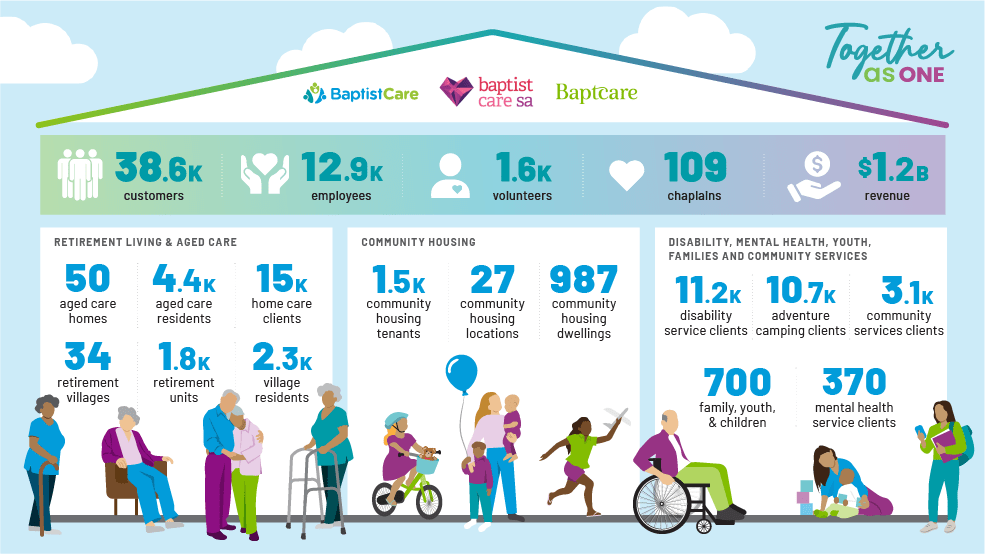
With $1.3 billion in annual revenue, 14,000 staff and 40,000 clients, the new entity is now one of the largest Not For Profit players in aged care and community services. But for Charles (pictured top), this is less about being big and more about being “stronger together” – and it could provide a blueprint for other Not For Profits navigating an uncertain future.
Two years after BaptistCare NSW & ACT and Baptistcare WA merged, BaptistCare (NSW, ACT, WA), Baptcare (VIC, SA, TAS) and Baptist Care SA formally joined forces in March, creating a billion-dollar aged care and retirement living powerhouse.
BaptistCare has also continued to grow steadily through acquisitions, with recent deals including Presbyterian Aged Care’s last retirement villages and aged care homes in Sydney, and Sunrise Supported Living’s retirement village and home care service on the NSW Mid North Coast
“Too many mergers just change the sign on the front door,” Charles told SATURDAY. “We are determined to optimise – to actually integrate systems, people and culture so that the benefits are real.”
To do this, BaptistCare set up a dedicated transformation office, ensuring integration was properly resourced rather than piled on top of frontline teams already under pressure.
Early results include stronger cybersecurity and privacy protections, the consolidation of leadership with almost 100 new general managers to link strategy with frontline services, and a new board and executive team to set direction.
Charles’ guiding principle has been simple: customers and staff should not notice disruption – “if anything, they should already be seeing improvements.”

Entering a three-sided marketplace
The BaptistCare story is about more than just integration. Charles believes the sector is heading into a new era – what he calls a three-sided marketplace.
“It used to be the Government funded providers to deliver services and the customer was almost incidental,” he said. “Now the customer has the funding and the rights. We need to compete for their trust and their business.”
The implications are significant. Baby Boomers – a generation that has shaped every market they’ve touched – are now ageing into the system.
“They’ve had a voice their whole life. They’ve changed Governments when they didn’t like something. Do you think they’ll hesitate to change providers?” Charles asks.
The pressure on mid-sized providers
To meet these expectations, BaptistCare is investing heavily in digital systems and processes designed to reduce friction for customers.
Charles says Baby Boomers will expect seamless, personalised service – “they’ll expect operators to have a deeper understanding of their needs and preferences than ever before” – and providers unable to deliver will be left behind.
That challenge will accelerate consolidation across the sector, Charles predicts. At one end, large players with strong balance sheets will continue to expand. At the other, small niche providers will survive by being agile and highly specialised.
The group in the middle – mid-sized providers – are in the toughest position.
“They’re too big to be nimble, but too small to invest at the scale needed,” he said. “That’s where we’ll see the most duress.”
Capital structures must evolve
Supporting growth will also require new approaches to funding. Charles believes the sector will increasingly rely on sophisticated capital structures, blending debt and equity to finance both mergers and development.
“I think we’ll see greater use of leverage, and larger players becoming more sophisticated in how they deploy other people’s money,” he said.
For Not For Profits, that means moving beyond traditional bank debt and adopting models more familiar to corporates and property groups – a shift Charles sees as essential to funding the scale of growth required.
Mission before margins
Consolidation is not without its (many) critics, but for BaptistCare the case is clear: efficiencies free up funds that can be reinvested into mission.
The organisation already operates beyond aged care, with significant community services programs ranging from affordable housing to support for women escaping domestic violence.
“If we don’t generate a surplus, who will plug that gap?” Charles asks. “Not For Profits like us are effectively subsidising the taxpayer by delivering vital services Government doesn’t necessarily fund.”

The gaps Government won’t fill
Charles is also vocal on policy blind spots. He warns that regional and remote services are being left behind because funding models don’t reflect the true costs of care.
Labour shortages, lack of housing, and long travel times make many areas unviable – even for experienced providers.
Without an “equity conversation” about how services in rural and remote communities are supported, whole regions risk being left without care.
The danger, Charles said, is that Government assumes the job is done – a fact we have seen in recent commentary by Mark Butler.
“We’ve poured the foundations, but now we need the scaffolding, the cladding and the roof. If Government walks away, the foundations will rust, and we’ll be starting again in five years.”
A model for the sector?
For Not For Profits, BaptistCare’s journey offers both a warning and a model.
The warning: standing still is not an option in a market defined by new consumer expectations, workforce shortages and financial headwinds.
The model: consolidation, done properly, can build resilience, efficiency and impact without compromising mission.
“We’re a startup with $1.3 billion of revenue and 14,000 staff,” Charles stated. “That means we can take the best of what we have, put the customer at the centre, and build something new. That’s the opportunity.”
For other Not For Profits, the question is whether they are ready – or able – to take it.


