
Is this aged care’s smartest acquisition?


Anglicare Sydney’s acquisition of Infinite Care may turn out to be one of the smartest deals we’ve seen in aged care for some time.
On the surface it looks like a straightforward expansion play: 18 homes, more than 2,100 beds and a footprint stretching across New South Wales, Queensland, Victoria and South Australia.
But the strategy behind the move is what makes it interesting.
For years, Anglicare Sydney CEO Simon Miller (pictured top) has been open about the organisation’s geographic limits. Because the provider sits within the Sydney Anglican Diocese, its operations have traditionally been confined to Sydney.

The 2022 decision to acquire 50% of LDK Seniors’ Living created a clever workaround, giving Anglicare exposure to Canberra and integrated seniors living models without crossing diocesan lines.
Now the Infinite Care deal takes that thinking a step further.
It instantly lifts Anglicare’s residential aged care footprint to around 5,000 beds across 42 homes – a number that carries its own significance.
Four years ago, Simon told SATURDAY that reaching 6,000 beds was the kind of scale required for a provider to remain competitive and sustainable in the future aged care market – see his slide from his 2023 LEADERS SUMMIT presentation below.
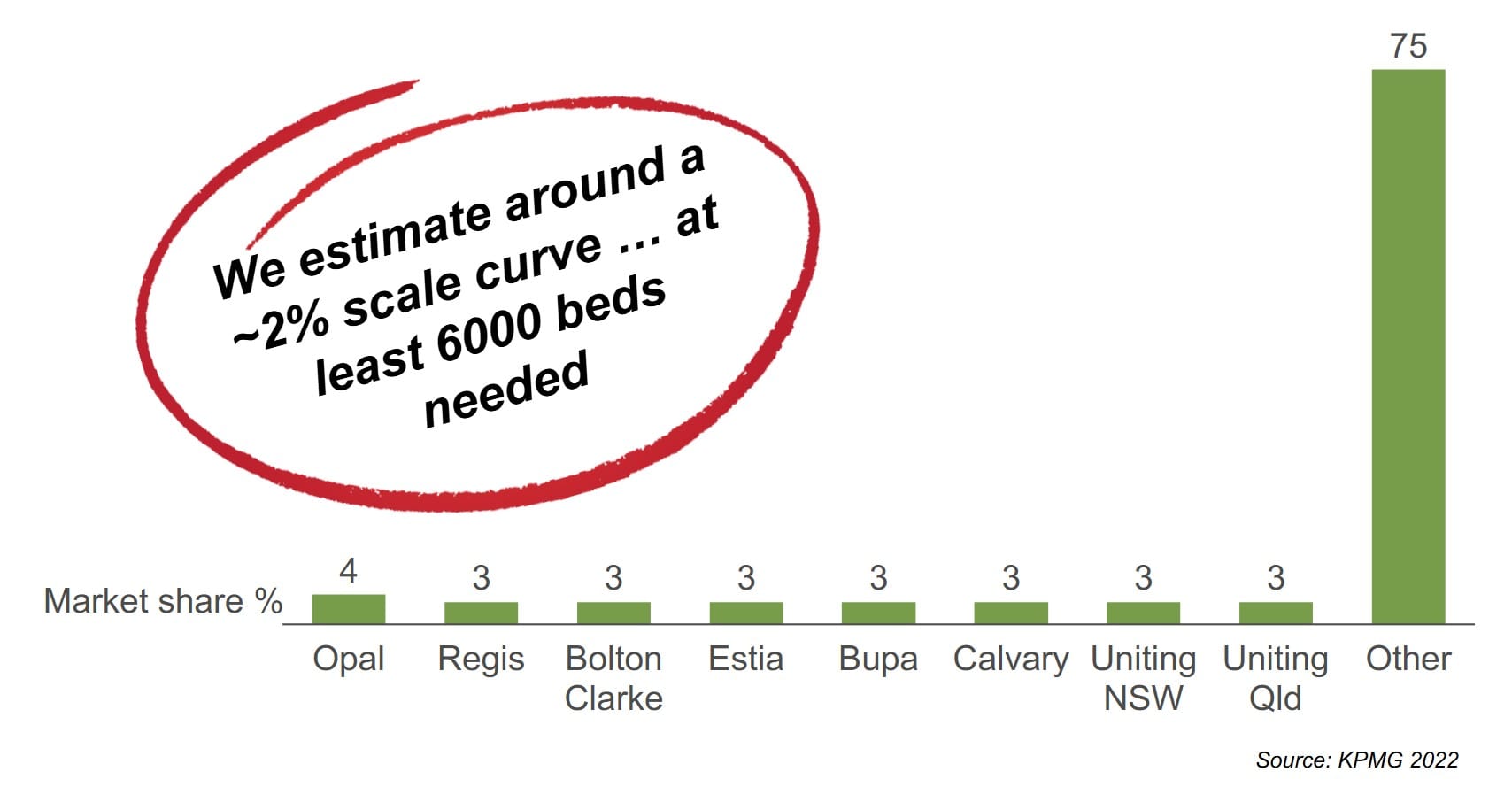
This deal moves Anglicare much closer to that target.
Buying beds makes sense
The acquisition also reflects a broader shift underway across aged care.
Right now, buying beds often makes more sense than building them.
Construction costs for new residential aged care homes are typically sitting somewhere between $500,000 and $600,000 per bed, depending on location.
Acquiring an existing operator, by contrast, delivers immediate capacity, an established workforce and operating revenue from day one.
In a sector where demand already exceeds supply – and where Australia is running short of aged care beds – that speed matters.
The underlying equation is also shifting.
Demand will continue to grow with the ageing population, while funding reforms such as RAD retention and potential accommodation pricing changes are expected to gradually strengthen the investment case for residential aged care.
For organisations with the balance sheet to move, acquisitions are increasingly the fastest path to growth.
Not For Profit consolidation
Anglicare’s move also fits into a wider trend.
Across the sector, large Not For Profit providers are steadily consolidating.
BaptistCare’s multi-state merger created a $1.3 billion organisation spanning five states. Bolton Clarke has built scale through acquisitions such as Allity and McKenzie Aged Care.
The thinking is simple: scale brings resilience.
Larger providers can absorb regulatory change, invest in new care models and manage capital requirements in ways many smaller organisations struggle to match.
Anglicare’s deal adds another interesting twist.
Infinite Care has historically operated as a private provider. Under Anglicare’s ownership, it will sit within a Not For Profit structure – bringing financial benefits such as payroll tax exemptions and salary sacrificing.
The bigger signal
What Anglicare has done is recognise if you want to grow quickly, acquiring quality assets is often the most efficient way to do it.
Building new homes will always be necessary – but right now it is expensive, complex and slow.
Buying an established platform delivers scale overnight – and with this deal, Anglicare has taken a decisive step toward the kind of scale its own CEO predicted would matter.


