
MYEFO 2025-26: Aged care slips down Canberra’s priority list
In short, the sector has moved from growth mode into fiscal restraint – just as providers are absorbing the cost and complexity of the new Aged Care Act.


For the first time in years, aged care has fallen out of the Commonwealth’s top tier of Budget pressures – and that shift is significant.
The Mid-Year Economic and Fiscal Outlook (MYEFO) 2025-26 shows aged care is no longer among the five fastest-growing spending lines. Instead, the biggest pressures now facing the Budget are:
- Interest on Government debt
- NDIS
- Defence
- Hospitals
- Medical benefits
- With childcare close behind
Aged care – once one of the fastest-growing major payments – has dropped off the chart.
What’s driving the change?
Aged care payments are now forecast to grow at an average of 4.9%, down from 5.2% at the Pre-election Economic and Fiscal Outlook (PEFO) and below nominal GDP growth.
In short, the sector has moved from growth mode into fiscal restraint – just as providers are absorbing the cost and complexity of the new Aged Care Act.
What MYEFO is funding – and what it isn’t
The 348-page financial outlook reveals the Government is doubling down on ageing at home – but within a tighter envelope:
- $947.8 million over two years from 2025-26, which includes the 20,000 additional Home Care Packages released by 31 October 2025 and the 63,000 Support at Home places to be released by 30 June 2026
- $8.9 million over three years for Aged Care Research and Industry Innovation Australia (ARIIA)
But from 2027-28, home care funding turns negative (see main image above), reflecting $255.7 million in savings over four years – and $21.9 million per year ongoing – through tighter targeting and consolidation, including:
- $112.8 million reprioritised from unspent Support at Home thin-market grants
- $80 million reprioritised from unused CHSP growth funding
- $62.8 million consolidated into the Dementia and Aged Care Support Fund
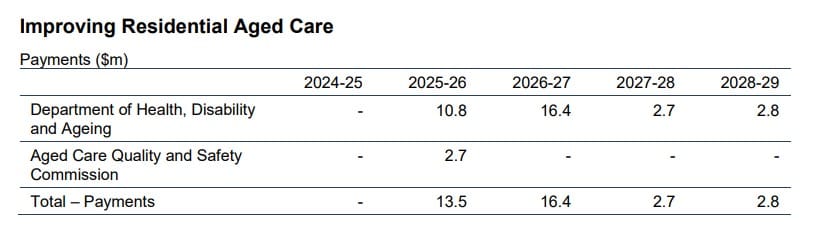
In residential aged care, MYEFO commits $46.5 million over four years – plus $5.8 million ongoing – to keep the program stable, including:
- $18.3 million to embed outbreak management into Transition Care and MPS
- $9.4 million to extend the Dementia Training Program
- $6.4 million to support younger people exiting residential aged care
- $5.8 million to extend AN-ACC transition funding in thin markets
- $4.6 million to improve food and nutrition
- $2 million to strengthen IHACPA pricing and assurance functions
A separate, previously announced, $60 million commitment will fund a new residential aged care home in Darwin.
The takeaway
MYEFO makes it pretty clear: aged care is no longer one of Canberra’s runaway Budget blowouts. The focus is on home care first, residential only where it has to, and tighter discipline across the board.
For providers, the message is blunt. The Government will keep funding operators – but there is no big funding wave coming to save the day.


