
Opinion: ‘care’ is now a non-negotiable for village operators – and Government
Assisted living is emerging as the sustainable future for retirement and aged care providers – but fixing the home care crisis must be the priority. As the first wave of Baby Boomers turns 80 this year, demand for ageing services is projected to...


Assisted living is emerging as the sustainable future for retirement and aged care providers – but fixing the home care crisis must be the priority.
As the first wave of Baby Boomers turns 80 this year, demand for ageing services is projected to rise by 40% over the next five years.
But we’re not keeping pace. We haven’t built 40% more retirement villages. The home care workforce hasn’t grown by 40%. Nor have we added 40% more aged care beds. Meanwhile, the hospital system continues to buckle under pressure. There is, however, a significant opportunity. Around 60% of Baby Boomers hold substantial wealth and are willing to spend it – a compelling incentive for providers. Check out the graph below from the Retirement Living Council’s ‘Removing Rightsizing Roadblocks: Age Pension and Commonwealth Rent Assistance Reform’ paper released last month. As you can see, the paper – compiled by Ansell Strategic – has identified a 1.6 million-strong middle market of over-65s who own their own home outright. As of April 2025, the national median house prices was sitting at $892,000.
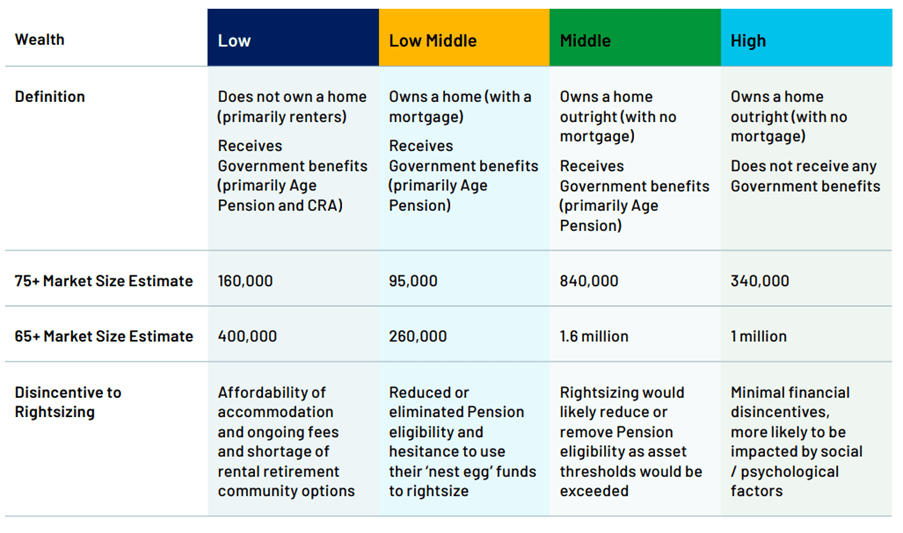
There is also a small cohort of 400,000 over-65s, mainly renters, facing a shortage of affordable rental retirement options. Both of these groups will require solutions to help them age well. As this edition explores, assisted living – meaning continuum-of-care villages and services for those who can’t remain at home but don’t yet require residential aged care – is gaining traction as a viable solution. Operators like LDK Seniors’ Living and Odyssey Lifestyle Care Communities have proven that the private assisted living model can deliver value for both residents and providers. Now, new and expanding players such as Torrens Living and Seasons Seniors’ Living are showing how assisted living can strike the balance between customer expectations and commercial viability. From 1 July, the Department of Health and Aged Care will begin trialling Shared Care in retirement villages – pooling Home Care Package funding to pay for shared services like an on-site nurse. It’s a promising step that should encourage more village operators to embrace care. But significant barriers remain.

Challenge #1: A severe shortage of Home Care Packages
As previously reported in The Weekly SOURCE, over 81,000 older Australians are waiting for essential Home Care Packages – many for over a year. This backlog is driven by funding shortfalls, delayed assessments, and transition issues with the incoming Support at Home program. Providers warn the situation is likely to deteriorate further. Most assisted living models today depend on a combination of Home Care Packages and private funding from residents. While more Australians will retire with superannuation savings and opt for privately funded care, many will still rely on a Government-funded Package to access basic services.
Challenge #2: Supporting those who can’t afford to pay
A smaller, yet critical, cohort of older Australians – often in lower socio-economic communities – simply cannot afford private care. Some operators are adapting. Seasons, for example, has transitioned five of its older communities (pictured) to a rental model with embedded home care services.

But again, the success of such models hinges on resolving Challenge #1. One of the key action areas highlighted by CEOs in our political wishlist series was the need for a national home care supply strategy. While the Federal Government has pledged to reduce wait times to three months by 2027, the harsh reality is that many older Australians are dying while still on the waitlist. A two-year timeline doesn’t pass the pub test. With the re-elected Labor Government now finalising its ministerial appointments, the time is ripe for the sector to step up and advocate for a unified, long-term vision for ageing and care in Australia. Care is no longer optional. It is essential. And it must be accessible – now.


