
The top three problems with aged care reforms


Less than three months into the new aged care regime, submissions to a Senate review of the Aged Care Rules have revealed providers are already grappling with significant issues.
In its submission to the Senate Inquiry into the Aged Care Rules 2025, the peak body for aged care providers, Ageing Australia, revealed members have “significant concerns” with the “cumulative administrative burden” of the reforms.
The new Standards are “overly complex and bureaucratic” and “require extensive documentation”. Plus, care plans are “longer and more complex”, writes the submission’s author, Roald Versteeg, General Manager Policy and Advocacy with Ageing Australia.
“It is critical that the rules are workable, proportionate and aligned with contemporary clinical governance, workforce capability, and sustainable service delivery,” the submission states.
Members tell Ageing Australia that the increased administrative burden has an increasing “financial and workforce impost”.
Ageing Australia recommends the Senate Community Affairs Legislation Committee conducts an examination of what requirements can be “streamlined or removed”.
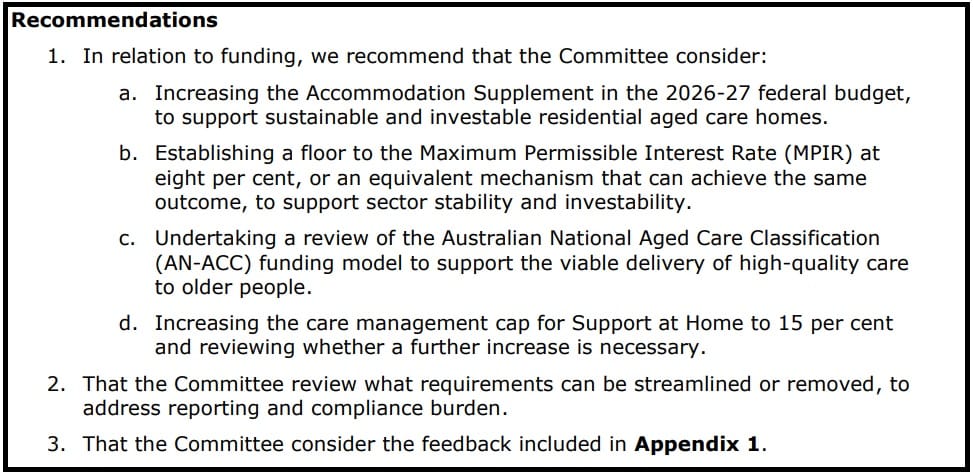
Todd Yourell, CEO of regional NSW provider St Andrews Village Ballina, warned that aged care homes could close due to the added administrative burden.
Todd’s top recommendation: changes to “simplify documentation and evidencing requirements”.
“The Aged Care Rules 2025 significantly expand documentation, evidencing and reporting requirements across quality standards, governance, restrictive practices, incident management, workforce oversight and provider accountability,” he writes.
“Without recalibration, the Rules risk accelerating service closures, reducing residential bed supply and undermining access to care, particularly in regional Australia.”
Funding
Both Roald and Todd also argued that aged care funding under AN-ACC is not keeping pace with the cost of delivering aged care.
Todd recommends the Independent Health and Aged Care Pricing Authority take “regional cost differentials” into account when setting prices.
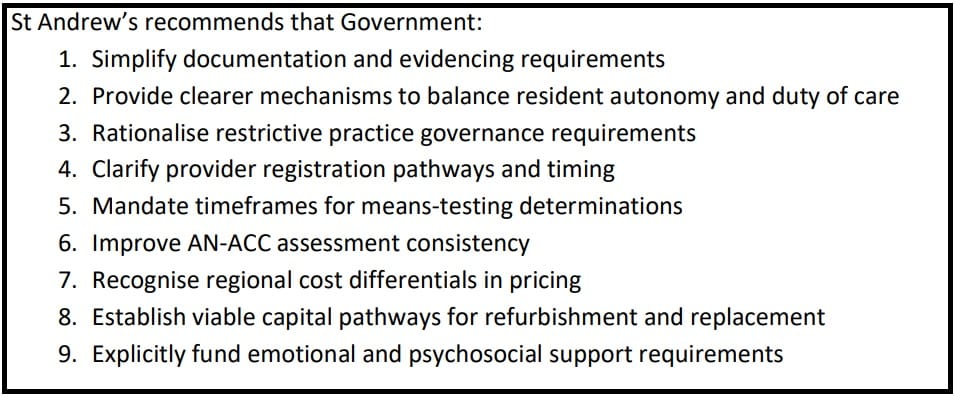
Ageing Australia reiterated their recommendations from their Pre-budget Submission, proposing a review of the AN-ACC funding model, as well as increasing the Accommodation Supplement, establishing an 8% floor on the Maximum Permissible Interest Rate, and increasing the care management cap for Support at Home to 15%.
HELF
Todd writes the new Higher Everyday Living Fee (HELF), introduced to replace additional service charges, has introduced “significant complexity for residents, families and providers”.
The added complexity and administrative burden could mean some “providers, particularly Not For Profit providers, may limit their use”.
Ageing Australia says the requirements for HELF are “negatively impacting” services, “ultimately reducing service offerings in the sector, and limiting options for individuals to receive additional services they want and are prepared to pay for”.
Ageing Australia notes the Department of Health, Disability and Ageing is undertaking an evaluation of HELF, including to assess whether the legislation is “fit for purpose and is achieving its policy intent”.
The Weekly SOURCE has forwarded questions about the evaluation to the Department.
Submissions close soon
The Aged Care Act 2024 requires certain Rules must be reviewed by the Senate within three months of the Rules being tabled in the Senate.
The Aged Care Rules 2025 were tabled in the Senate on 27 October 2025, with submissions to the Senate Inquiry to close 23 January 2026. The findings will be reported “as soon as practicable”.
With less than a week to go, only five submissions have been published on the Senate Inquiry’s website.
You can download the submissions here.


