
Two months from penalties, 1,000 aged care homes non-compliant over care minutes


The number of operators meeting mandatory total and RN care minute targets has soared in the last quarter before providers will be penalised for non-compliance.
Data from the Department of Health, Disability and Ageing for the September 2025 quarter shows 60% of aged care homes achieved both total and RN care minute targets, a sharp increase from only 44% compliance a year earlier.
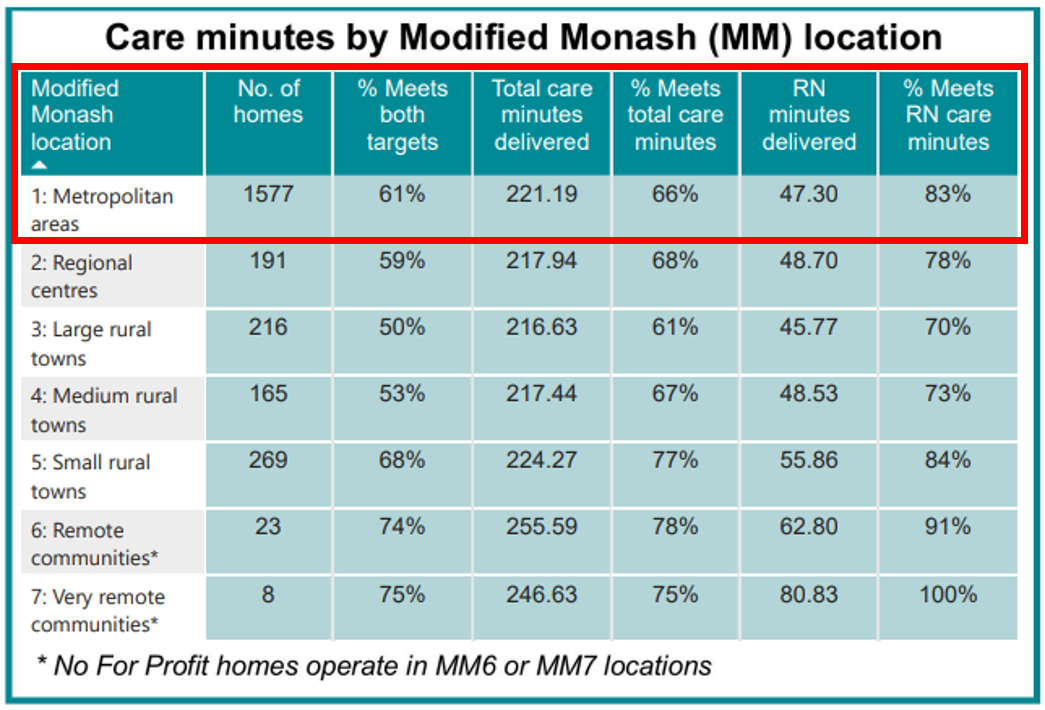
61% of metropolitan aged care homes – which will be penalised from 1 April 2026 for non-compliance – met both targets. Based on our calculations, that means around 1,000 aged care homes still don’t comply with the measures.
Penalties imminent
Mandatory care minute targets were introduced on 1 October 2023, when the Government required that aged care homes achieve an average of 200 total direct care minutes and 40 RN direct care minutes per resident per day.
A year later, from 1 October 2024, the targets increased to 215 direct care minutes and 44 RN minutes.
However, financial pressures and recruitment challenges held rates of compliance with both targets below 50%.
To improve rates of compliance, in December 2024, the Government announced changes to AN-ACC funding for metropolitan aged care homes.
From 1 April 2026, their National Weighted Activity Unit (NWAU) weighting will be reduced, to be replaced by a sliding scale determined by compliance with the mandatory care minute targets.
The change relates, at its commencement, to care minutes for the October-December 2025 quarter, the consecutive quarter to this latest data.
Operator could lose up to $33.41 prpd
According to the UTS Ageing Research Collaborative (UARC), metro aged care operators could lose up to $33.41 per resident per day in Base Care Tariff (BCT) funding from 1 April if they don’t meet the targets.
However, there may be financial incentives for some providers to wear the penalty and still come out ahead financially, UARC Chair Professor Mike Woods wrote in the mid-year 2024-25 UARC report.
UARC analysis shows aged care homes that meet care minute targets often have lower margins and use higher-cost staffing practices such as more agency staff and greater use of overtime.
The analysis also found compliance with the RN target (81%) has consistently outpaced compliance with the total direct care target (67%), suggesting personal care worker shortages are a significant cause of non-compliance – an intractable challenge.
A constraint on productivity
Given the residential aged care sector is estimated to be short of 22,000 direct care workers this financial year, it will be challenging for metro homes to achieve 100% compliance with both targets.
The Government is conducting a virtual nursing trial, with a two-year pilot concluding in 2027, which could provide a future alternative to help homes meet the targets.
Care minutes targets are also a handbrake on productivity. UARC states that mandatory care minutes targets constrain operators when it comes to innovative models of care.
“Government specification of the quantum of care minutes to be used as inputs has constrained providers’ abilities to be in the models of care they adopt to achieve the desired outcome of higher quality care,” it reported.
As aged care operators move to increased compliance with the mandatory care minute targets, they are expected to see margins erode, and they will be forced to employ higher-cost labour.
If financial penalties don’t motivate operators to comply, is it time for the Government to rethink mandatory care minute targets?


