
‘Unfundable within five years’: St Vincent’s bold home-first plan to rebuild the system
On bricks and mortar, Chris is clear: the answer is not another wave of traditional hospital builds. “On average, we need fewer hospitals, more theatres and fewer beds,” he said.


Australia’s largest Not For Profit health and aged care provider has drawn a very clear line through the decade ahead: by 2030, half of all St Vincent’s care will be delivered in people’s homes or virtually in a fundamental redesign of where and how care happens.
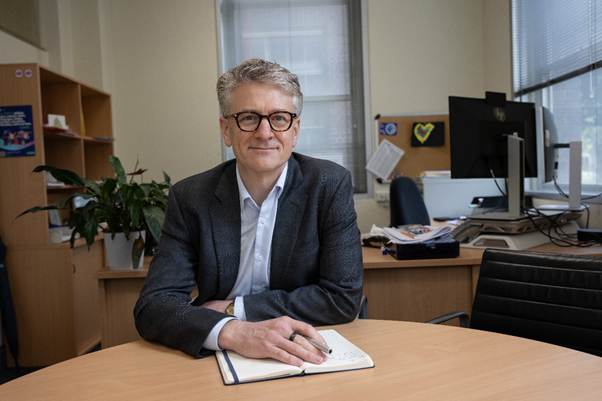
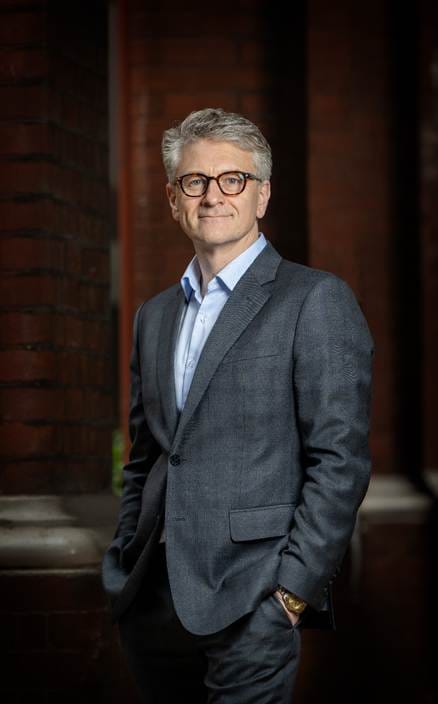
For CEO Chris Blake (pictured top), the reason was as stark as the ambition. On current settings, he said, the system is “unfundable within five years”. It is not a philosophical idea; it is mathematical – and the numbers are brutal.
“We have an ageing population, growing chronic illness and a workforce already exhausted. Demand is rising faster than funding can ever keep up,” Chris told SATURDAY. “Unless we change the model, not just the money, the system becomes financially untenable.”
St Vincent’s breadth of services gives it unusual power to act. It runs public hospitals, private hospitals, residential aged care, home care and world-class research institutes – effectively a microcosm of the national system.
Chris described it as a “sandpit for reform”, and the organisation now intends to use that position to lead.
Care where people live – not where the buildings are
The new 2030 commitment will shift half of all care delivery into homes and virtual environments.
That includes:
- hospital-level care in the home
- rehabilitation, palliative care and GEM
- stepped-down acute care for older people
- ongoing virtual monitoring and intervention
- earlier, preventative care delivered outside hospital walls
St Vincent’s already runs the equivalent of 200 virtual hospital beds and is one of the fastest-growing Hospital in the Home providers in NSW and Victoria. But the next phase is vastly more ambitious.
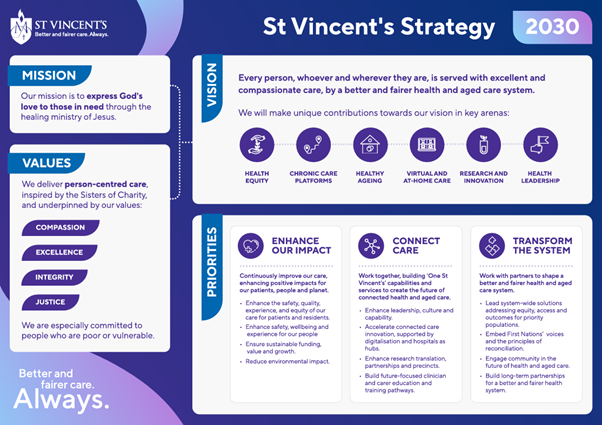
The organisation will build a national command centre capable of 24/7 remote monitoring using medical-grade wearables, AI-assisted triage and logistics-style coordination – industrial-scale virtual care designed to sit across hospitals, homes and aged care.
As Chris put it, St Vincent’s is “building Australia’s largest virtual and home care system,” enabling its clinicians to deliver half of care “in people’s homes – including aged care homes – either face-to-face or virtually.”
The logic is simple: if more continuing care can safely shift into the home, hospitals can focus on what only they can do – acute procedures, urgent interventions and complex diagnostics. Everything else can move closer to where people live.
On bricks and mortar, Chris is clear: the answer is not another wave of traditional hospital builds. “On average, we need fewer hospitals, more theatres and fewer beds,” he said – higher output in the right locations, with far more of the continuing care load carried outside hospital walls.
Why funding fixes won’t save us
A central pillar of Chris’ argument is that Australia keeps trying to solve structural problems with point solutions – a medi-hotel here, a day surgery there, tweaks to aged care payments – without changing the underlying machinery.
“All those things do is move the problem into a different part of the system,” he said. “We change who pays, not the underlying economics.”
Australia’s funding debates fall into the same trap. We argue about which bucket should pay – the Commonwealth, the States, private insurers, Home Care Packages, out-of-pocket contributions – when the real issue is that older people draw from all of those buckets, often simultaneously.
Treating any one bucket as “the solution” only limits innovation. For example, the top home care package – around $78,000 – is often framed as the ceiling for what someone can receive at home. Chris was direct:
“It’s the obvious question. It’s also the wrong one. That’s just one bucket.”
Real care, he said, requires “mixing funding sources around the person,” not designing services around a single program.
He also argued that superannuation must re-enter the discussion. For wealthier older Australians, super should be used “for what it was designed for – funding needs in retirement,” not simply as a tax-effective inheritance tool.
Above all, Australia must innovate within the financial reality.
“There is no more money coming,” Chris said. “Not at the rate of demographic need. So we have to design differently.”
That redesign, he stressed, can’t be left to Governments alone. “It has to be a partnership,” he said – Commonwealth and States, private health insurers, aged care and retirement living providers, unions and the community.
He likens it to the Hawke-Keating era economic reforms: “We need an accord-style approach where people sign up to change the system, not just shift costs around it.”

Aged care: the missing link in system redesign
Chris was blunt about the limitations in aged care and retirement living. The design of the average RAC home or retirement village “has not changed for decades”, he said – a legacy model built for a different era and now acting as a brake on system reform.
“If you’re driving looking in the rear vision mirror, you’re likely to hit something coming the other way,” he warned.
Too much of the system – from hospitals to villages – is still designed with the rear-view mirror, not the road ahead, in mind.
Yet aged care is where the most important redesign is needed.
With the right model, Chris argued, “probably 90%” of the higher-acuity episodes that currently send residents to hospital could be managed onsite. The obstacle is not infrastructure – it is the lack of clinically governed technology-backed connection to acute care.
This is where the hub-and-spoke model comes in. St Vincent’s plans to anchor care around world-class hospital precincts as hubs, with aged care homes, retirement villages and home-based services acting as spokes tied back to centralised clinical oversight.
Hospitals become destinations for specialised care and research – instead of holding bays for chronic and continuing care that could safely be managed elsewhere.
Workforce: not more workers – different work
Chris rejected the idea that aged care and health workforce pressures can be solved by “more of the same.”
“You can’t take the hospital clinical governance model and drop it into a home,” he said. Instead, entirely new roles, training pathways and supervision structures are needed.
He sees paramedics becoming continuous-care responders, not solely emergency staff, and anticipates the rise of digital intensivists – clinicians trained to combine clinical judgement with remote monitoring, data interpretation and last-mile care coordination.
Universities, regulators and providers will all need to rethink the boundaries of practice.
“It’s an inexorable shift,” Chris said. “We need to prepare for it now.”
Tech is no longer the barrier – scale is
What excites Chris isn’t any one technology but the convergence of many:
- medical-grade remote monitoring
- AI-supported triage
- logistics-style coordination
- telehealth
- precision medicine
Together, they form what he described as platform health – a system where data, clinical insight, monitoring and logistics operate as one. Other industries coordinate complex logistics at massive scale, he noted. Healthcare simply has not caught up.
From “random acts of excellence” to a world-class system
Across its network, St Vincent’s already has pockets of best practice: palliative care at home, rehab in the home, geriatric evaluation in the home, specialist geriatric teams in ED and innovative dementia programs.
Chris called these “random acts of excellence”. The new strategy is about making them the rule, not the exception.
One example is St Vincent’s geriatrician-in-emergency pilot at its Melbourne hospital. In its first months, hundreds of older people referred from ED were assessed by a specialist geriatric team – and around 60% were safely diverted from hospital admission, saving hundreds of bed days. Watch the video here.
It is the kind of model Chris wants to see hard-wired into the system rather than left as a one-off experiment.
“That’s why we say we’ve stepped through a one-way door,” he said. “This isn’t a strategy slide. We are changing activities.”
Australia, Chris argued, has the right ingredients – system quality, scale, research capability and demographic urgency – to build a world-leading home-first model.
As he put it: if we fail to transform, “we hand a massive burden to young Australians.” If we get it right, “we have a chance to lead the world.”
About Chris Blake
Chris Blake is the Chief Executive Officer of St Vincent’s Health Australia, the nation’s largest Not For Profit provider of health and aged care, spanning 16 hospitals, 23 aged care services, major research institutes and a workforce of nearly 30,000 people.
A recognised transformation leader, Chris previously spearheaded one of Australia’s largest cultural and operational change programs during his eight years at Australia Post, following senior executive roles at National Australia Bank and Latitude Financial Services. He spent almost two decades with PwC earlier in his career, becoming a national practice leader.
Despite a corporate background, Chris has a long-standing commitment to health and medical research. He serves on the Board of the Florey Institute of Neuroscience and Mental Health, chairs Brain Australia Pty Ltd and the Foundation for Imaging Research and sits on the advisory committee for the Australian Epilepsy Project.
Chris holds a Bachelor of Commerce from the University of Melbourne and brings more than 30 years’ experience in strategy, organisational transformation and purpose-driven leadership.


