
The big shifts: what moved aged care and retirement living in the first half of 2025
Delays, deals and digital disruption. The first six months of 2025 delivered a cocktail of reform uncertainty, consolidation, and bold moves from new players looking to shake things up. From the Government’s decision to delay the Aged Care Act and...


Delays, deals and digital disruption. The first six months of 2025 delivered a cocktail of reform uncertainty, consolidation, and bold moves from new players looking to shake things up.
From the Government’s decision to delay the Aged Care Act and Support at Home rollout, to the sector’s most significant M&A activity in years, it’s been a half-year of realignment, repositioning – and reckoning.
Here’s what mattered most.

1. Reform on ice – but not for long?
Support at Home and the Aged Care Act are both on pause until 1 November. That bought providers time – but it also created an uneasy vacuum. For some, like councils and community-run providers, it’s proved a final straw. Bundaberg Regional Council and many others have exited in-home care. So has long-running national provider Annecto, leaving 3,000 clients across multiple states in limbo. Home care is clearly heading for scale. The days of fragmented service delivery are numbered. But in the meantime, waitlists are blowing out – up 125% since mid-2023, according to KPMG – while aged care bed supply is barely moving. 83,000 new Home Care Packages have also been delayed until November. Not ideal, given the reform backlog – and the estimated 100,000 older Australians and their families currently waiting for services. Expect new Minister for Aged Care and Seniors, Sam Rae, and Minister for Health, Disability and Ageing, Mark Butler (pictured below) to face more heat as Parliament returns later this month.

2. Consolidation picks up pace
This is a market for the bold. Smaller providers are increasingly looking for lifeboats, while those with capital are moving quickly.

Among the biggest moves:
- Brookfield offloaded Aveo to Scape’s new seniors business, The Living Company, for $3.85 billion – Australia’s biggest direct real estate deal this year.
- Pacific Equity Partners bought out AMP’s 50% stake in Opal HealthCare, cementing its hold over the country’s largest private aged care operator.
- Three Baptist organisations completed their long-awaited merger, forming a single BaptistCare brand covering six states, 12,000 staff and over 38,000 customers (see below).
M&A isn’t just about growth – it’s also a response to tightening margins, higher wages, and compliance risk. Aged care is becoming a scale game – and investors are watching closely.
3. Land lease boom: new players, big ambition
If 2024 was about investor curiosity, 2025 is all-in. Land lease is booming – and with GemLife (led by founder and Managing Director Adrian Puljich, pictured below) now on the ASX and a flood of new players entering the market, it’s no longer just the Ingenias and Stocklands calling the shots.

In just six months, we have seen:
- ReGen Living (Oliver Hume) launch a $130 million masterplanned community in Geelong.
- Macquarie Asset Management's $2.85 billion venture into land lease living Millbray.
- Hamlet Living, founded by the nephew of Lifestyle’s co-founder, target 50-100 homes per site.
- DevCore, run by ex-Rawson Homes execs, announce six communities and 1,200-plushomes.
- Vivacity, led by Jonathan Steggles Mendez, pitch 1,000-plus homes across NSW and VIC.
- Liven Communities, backed by GreenFort and Gaw Capital, double its pipeline to 3,000 homes.
- WA Not For Profit Bethanie gain approval for its first land lease community.
Eureka Group, traditionally in seniors’ rentals, also made the move into all-age communities with several acquisitions. Why the rush? It’s a stable, scalable model. And for investors, it offers returns without the compliance overhang of aged care.
4. Funding, minutes and compliance pressure
Care minute compliance is biting. Despite a 6.5% lift in average minutes delivered in Q1 FY25, only 45% of residential homes hit the mandated benchmarks – see below.
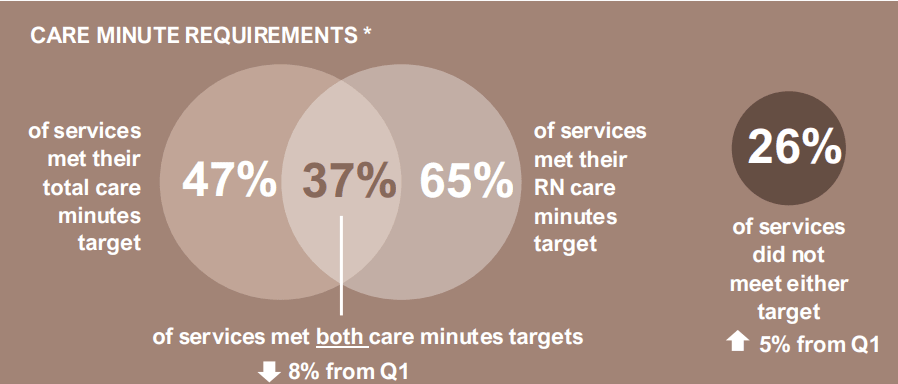
The regulator is on the move. The Aged Care Quality and Safety Commission is intensifying audits, especially in metro areas. And from April 2026, AN-ACC funding will be linked to compliance data from the December 2025 quarter. Layer in wage rises and growing scrutiny from the Commission, and providers are staring down tighter margins. There’s no reform relief yet – and with the Aged Care Act delay, there’s no new funding levers in play either.
5. Virtual nurses and smarter systems
The workforce crunch hasn’t eased – but tech is starting to deliver relief. Amplar Health, backed by a $30 million Federal Government grant and led by CEO Robert Read (pictured below), is trialling virtual nurses in 30 aged care homes. These RNs support clinical decision-making, care planning and documentation – freeing up on-site staff to focus on care.

With an estimated shortfall of 4,000 Registered Nurses in aged care, virtual nursing is emerging as a credible support model. Other providers are trialling remote wound care, triage bots and AI-driven rostering. Meanwhile, the Department is rolling out ICT reforms, pushing for integrated finance, clinical and compliance platforms. Providers are being told to clean up their data and prepare for live reporting to government systems. Whether those Government systems are working is another question – but if your backend isn’t stable, now’s the time to sort it.
6. Retirement living: new rules, new models
Every state except Tasmania is currently undergoing reform, with the most significant changes underway in Victoria. Victoria’s Retirement Villages reform bill landed in May, with changes expected to roll out in 2026. Expect new requirements for transparency, consumer protections, exit entitlements and contract simplicity. Operators will need to adjust governance, pricing and communication models – but most welcome the clarity. The shift could help restore consumer confidence in a sector often mired in confusion and inconsistency.

At the same time, more providers are moving into hybrid models. Care suites, concierge services, and onsite health partnerships are becoming standard in new developments (see Hyecorp’s Hyegrove Willoughy project, pictured above and below, as a prime example).

And as Cranbrook Care’s exit from aged care shows, many are walking away from residential high care to double down on retirement living – but still delivering support through allied health, home care, or in-house teams.
7. Liquidity rules bite – just not as hard
The ACQSC spooked providers in February with a draft proposal to impose a 10% liquidity requirement on aged care operators with retirement villages. After sector pushback, that was revised down to 2% – but the message stuck: cash buffers are now under scrutiny. Ageing Australia is urging members to tighten reporting systems and financial governance. The regulator wants to avoid another collapse like Earle Haven – and boards are on notice. Capital planning, debt servicing and refund liabilities are all under the microscope. If you don’t know your cash burn or liquidity profile, now’s the time to find out.
Final word
It’s been a half-year of adjustment, anticipation – and in many cases, acceleration. Providers with scale, smart systems and a clear strategy are pressing ahead. Those without are circling the wagons or heading for the exit. If 2024 was about preparing for reform, 2025 is shaping up as a proving ground. Ready or not, change is here.


