
St Vincent’s is predicting the collapse of the health system as we know it – by 2030.


St Vincent’s Health Australia says ‘the maths don’t work’. Demand is outstripping supply of all components of the health system. The only solution is a redesign based on technology and virtual health into homes, villages and RACs.
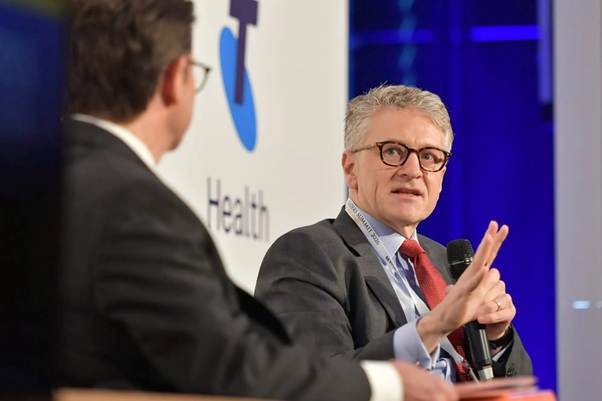
Australia’s largest Not For Profit health and aged care provider St Vincent’s is preparing for a future where half of all care interactions happen outside traditional hospitals and aged care homes by 2030 – and CEO Chris Blake (pictured top) says the current system is nowhere near ready.
Speaking to SATURDAY for its special final edition of 2025, Chris summed up the dire situation facing the country within the next few years.
“We have an ageing population, growing chronic illness and a workforce already exhausted,” he underlined. “Demand is rising faster than funding can ever keep up. Unless we change the model, not just the money, the system becomes financially untenable.”
At the 2026 LEADERS SUMMIT, Chris outlined his solution: a sweeping “hub and spoke” strategy that would connect residential aged care, retirement villages, home care and virtual services back to central high-acuity clinical hubs.
“More care, more distributed,” Chris told SUMMIT delegates.
“And not being so committed to the old structures of where care was delivered.”
Under the model, villages and aged care homes effectively become spokes – connected digitally and clinically into broader health infrastructure, with remote monitoring, interoperable health records and virtual care helping deliver higher-acuity services outside hospital walls.
Building the virtual network
The strategy would see St Vincent’s expand hospital-level care in the home, rehabilitation, palliative care, geriatric evaluation and management, stepped-down acute care for older people, ongoing virtual monitoring and earlier preventative intervention designed to keep people out of hospital for longer.
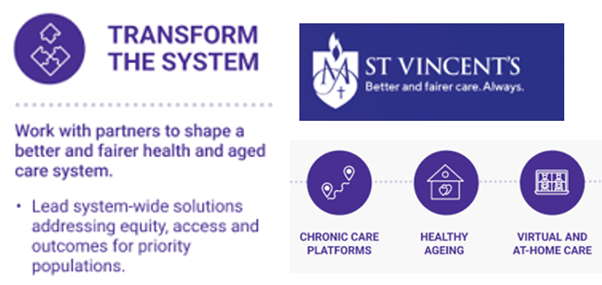
St Vincent’s already runs the equivalent of 200 virtual hospital beds and is now one of the fastest-growing Hospital in the Home providers across NSW and Victoria.
The next phase involves building a national command centre operating 24/7 using medical-grade wearables, AI-assisted triage and logistics-style coordination across hospitals, homes and aged care.
The shift also reflects a wider rethink occurring across ageing and healthcare, with Chris Baynes arguing in this edition that Governments may increasingly reward providers that achieve wellness and reablement outcomes – and penalise those that fail to keep people healthier for longer.
Chris Blake said the current system remained organised around funding silos rather than people.
“These are all products of funding,” he said.
“The structures have been built for those funding silos, not for the care silos.”
Seeking partners
The strategy is already reshaping St Vincent’s internally. With a workforce of 30,000 people spanning hospitals, aged care, research and community services, Chris said the organisation spent the past three years redesigning its own operating model before attempting broader system reform.
Importantly, Chris said St Vincent’s is actively seeking partners across the sector to make the model work.
“You can’t do it as a single node within the system,” he said.
For providers, the message is clear: the next phase of aged care may not be about standalone facilities at all – but about who can connect into the right clinical network fastest.
Not a member and want to keep reading SATURDAY? Click here to access the 30 day free trial.


