
Aged Care Budget 2026-27: Incremental funding, unfinished reform


The 2026-27 Federal Budget delivers a $3.7 billion funding boost for aged care, continuing a pattern of targeted investments announced ahead of Budget night. Treasurer Chalmers’ Budget, aligned with Minister Butler’s National Press Club address in April, contained few surprises for the sector.
While the additional funding is welcome and necessary, the broader question remains unanswered: does this Budget place aged care on a sustainable footing for the future?
The Government has pointed to additional funding for in‑home personal care, specialist dementia services, increased residential capacity, and the extension of end‑of‑life pathways as evidence of meaningful reform. These measures address genuine areas of need, and few would dispute their importance.
However, taken together, they represent incremental progress rather than structural reform. The scale of the challenges facing aged care – rising demand, workforce shortages, thin provider margins and constrained investment – extends well beyond the scope of this Budget.
Support at Home: promise still unproven
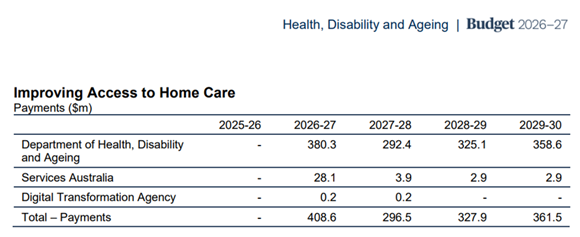
The Government’s flagship Support at Home (SAH) reform remains in its early stages, with critical design and implementation issues unresolved. While SAH is intended to improve access and responsiveness to in‑home care, waiting times for services continue to exceed 12 months in many cases. The Budget does little to demonstrate how this gap between policy intent and service delivery will be closed.
It is also legitimate to question whether the transition from Home Care Packages to SAH has resulted in improved clinical care outcomes. Under the former EACH(D) program, service delivery hours were more than double those currently available to many clients. Community expectations and demand have continued to grow, yet SAH has some distance to travel before it can meet current needs.
Residential aged care: critical requirement for new beds
The $1.7 billion budget measure to incentivise up to 5,000 aged beds a year is on its own insufficient with an average of 10,000 new beds required each year, but in any case, these funds need to flow now.
The excellent Independent Review of Accommodation Pricing recommendations must be implemented straight away and then let the discussion focus on the actual funding quantum required rather than wait for more consultation.
Provider viability and investment signals
A persistent weakness in the Budget is the lack of attention to provider financial sustainability. Current funding and pricing settings are not generating returns sufficient to encourage new entrants or further investment, particularly in a capital‑intensive and highly regulated sector.

SAH fee price caps alone risk constraining supply rather than improving affordability. Without adequate margins, providers are unable to expand services, invest in workforce capability, or innovate new models of care. Over time, this undermines access, choice, and quality for older Australians.
With respect to residential aged care, much discussion centres around the investability. StewartBrown’s latest Survey shows an average operating EBITDA result of only $4,582 per bed per annum (a minimum of $20,000 per bed per annum being required), and with 61% of homes making an operating loss. This is clearly a significant issue.
The operating deficits are due to the reduced AN-ACC margin and negative margins for everyday living and accommodation. The budget offers little to rectify this, and the additional $5 per day for financially supported residents will not change the financially sustainability dial in any meaningful way.
The bigger picture
The Budget reinforces a longstanding concern within the sector: funding increases have not been matched by the deep structural reform needed to support an ageing population. Demand for aged care – particularly in‑home care – will continue to grow rapidly. Without sustainable funding models and clearer investment incentives, the system risks falling further behind community expectations.
Increased funding is essential, but it is not sufficient. Future budgets will need to confront the hard questions around pricing, workforce supply, investment returns and service delivery capacity. Until then, aged care reform remains unfinished business.
Grant Corderoy is a retired Senior Partner at StewartBrown with over 40 years involvement in the aged care sector. The views expressed in this article are not necessarily endorsed by StewartBrown.
Not a member and want to keep reading SATURDAY? Click here to access the 30 day free trial.


