
Accommodation Review lays bare aged care’s supply failure


- Demand rising fast: Need expected to more than double by 2044, outpacing supply
- Build gap widening: ~10,600 places needed annually — far above current output
- Funding constraints: Current model is limiting new development
- Reform essential: Major changes needed to unlock investment and boost supply
Australia’s aged care system is facing a construction task it has been unable to achieve – and under current settings, is not on track to deliver.
The 83-page Independent Review of Residential Aged Care Accommodation Pricing – released yesterday – finds the sector must add around 10,600 new places each year for the next 20 years – the equivalent of opening a new aged care home every three days, a line that Federal Health and Aged Care Minister Mark Butler has been driving repeatedly in recent media appearances.
The Review, announced in October 2025, was led by Nigel Ray, Deputy Chair of the Aged Care Taskforce and former Deputy Secretary at the Department of the Treasury, and Associate Professor Nicole Sutton, co-founder of the University of Technology Sydney’s Ageing Research Collaborative.
The Review comes as the Federal Government has announced a $3 billion aged care package targeting 5,000 new beds a year – around half the level of growth identified in the report.
Demand accelerating, supply falling behind
Demand for residential aged care is expected to more than double from 198,302 people in 2024 to 409,677 by 2044, driven by population ageing and increasing complexity of care needs.
While the expansion of the Support at Home program is also critical to delaying entry, it will not replace the need for residential care for people requiring 24-hour support, the report notes.
But supply trends are moving in the opposite direction, with growth slowing to around 1,470 places per year since 2020, and just 802 places added in 2024-25 – see below.
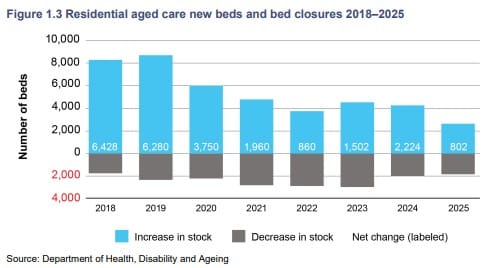
“Ensuring sufficient and sustainable supply has become one of the most pressing challenges for the sector,” the report states.
“Without decisive action to expand and maintain the sector’s accommodation capacity, older people will face increasing difficulty accessing care, and the system risks becoming less affordable and less equitable.”
Current model holding back new beds
The Review finds the current funding model is constraining development.
New builds depend heavily on Refundable Accommodation Deposits (RADs), concentrating investment in higher-income areas, while Daily Accommodation Payments (DAPs) are too volatile to support financing.
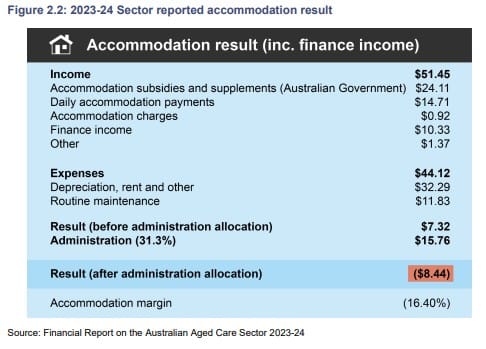
Funding for supported residents has also not kept pace with construction costs, while providers are operating on thin margins, with average net returns of around 1.3%.
A full reset: the 18 recommendations
The Review sets out 18 recommendations, grouped across capital, pricing, equity and system capability:
1. Supporting capital investment and supply (Recommendations 1-6)
The Review proposes a significant shift in how aged care development is financed, including:
- A $2 billion per year interest-free loan scheme over 10 years to support new builds and refurbishments, with loans tied to the proportion of supported residents – which Minister Butler said the Government will consult with the sector on
- New capital subsidies:
- $30 per day per supported resident for new homes (to be available to providers for 25 years and subject to the same indexation as the accommodation supplement)
- $15 per day per supported resident for major refurbishments (paid for 15 years with the same indexation requirement – in both cases, homes that have been funded by Government grants would be excluded)
- Expansion of the Aged Care Capital Assistance Program (ACCAP) to at least $600 million per year for the next 10 years, targeting rural, remote and thin markets
- Streamlining planning approvals and addressing shortages of builders with the qualifications to build residential aged care homes
- A national census of aged care infrastructure to track bed supply, condition and expansion capacity and provide real-time data on offline beds
2. Reforming accommodation payments (Recommendations 7-11)
The Review also recommends changes to pricing settings to improve flexibility and investment certainty, including:
- Removal of the Maximum Permissible Interest Rate (MPIR) as the link between RADs and DAPs
- Allowing providers to set their own conversion rates between lump sums and daily payments
- Shifting room price caps to a DAP basis – a measure that StewartBrown have advocated strongly on
- Simplifying approval processes for higher-priced rooms and removing the requirement to reapply every four years
- Maintaining price controls by rejecting mandatory minimum prices for non-supported residents
3. Preserving equity of access (Recommendations 12-16)
To improve access for lower means residents, the Review proposes:
- Increasing the base accommodation supplement by $5, lifting it above the current maximum of $52.15 and removing lower tiers
- Increasing the higher accommodation supplement by $5 per day and introducing three tiers based on supported resident mix:
- 0-29% supported residents: $59.23 per day
- 30-39%: $66 per day
- 40% or more: $77.30 per day
- Requiring partially supported residents to pay the lowest of:
- $52.15 (or $77.30 for higher-supplement homes)
- their means-tested contribution
- or the agreed accommodation price
- Introducing a $20 per day loading for homes where supported residents make up 60% or more of the cohort
- Requiring existing homes to maintain supported resident ratios within five percentage points of their 2024-25 levels, initially for three years
4. Improving transparency and consumer support (Recommendations 17-18)
The final recommendations are directed at helping consumers better understand and navigate accommodation pricing, including:
- Development of standardised information materials explaining accommodation pricing and payment options
- Expansion of advisory services, including the Services Australia Aged Care Specialist Officer and Financial Information Service programs
No single fix
The Review concludes the scale of the challenge cannot be addressed by a single policy lever.
Instead, the report calls for a coordinated approach combining Government capital, private investment and regulatory reform.
Even with reform, it warns that supply constraints are expected to persist in the short term due to the time required to deliver new capacity.
In short, Australia does not just need more aged care beds – it needs a system capable of building them, and the current model won’t deliver that.
Download the full report here.


