
Care funding still subsidising aged care losses: Govt report


- EBITDA declines: Operating earnings fell 6.5% despite higher sector income
- Care cross-subsidises losses: Care profits funding accommodation and living losses
- Costs keep rising: Labour and care expenses continue squeezing margins
- Earnings outlook weak: StewartBrown survey shows further deterioration in 2025-26
A Government report on the aged care sector shows continued strain on operator earnings.
The Government’s Financial Report on the Australian Aged Care Sector 2024-25 shows at a sector level, Earnings before Interest, Tax, Depreciation and Amortisation (EBITDA) fell 6.5% to $2.4 billion in 2024-25, down from $2.5 billion in 2023-24.
The result is equivalent to EBITDA of $32.43 per resident per day (prpd), a 8.9% decline from the $35.61 result in 2023-24.
The EBITDA margin declined 1.2 percentage points (pp) to 6.9%, down from 8.1% in 2023-24.
Earnings look set to remain under pressure this financial year. Aged care accountants StewartBrown’s residential aged care survey for 1H 2025-26, published in May, showed earnings deteriorated in the first half of 2025-26.
The StewartBrown survey – which captures responses from 1,200 residential aged care homes, representing 46% of the sector – showed residential aged care home operating earnings fell from a surplus of $1.56 pbd in 1H FY25 to a deficit of $9.80 per bed day (pbd) deficit in 1H FY26.
The Government’s Financial Report showed expenses rose 8.4% in 2025-26, driven by a 13.6% increase in labour costs, and a 24.9% increase in other care expenses. Total income rose 9.8% to $34.3 billion, up from $31.2 billion in 2023-24, driven by a 13.4% increase in care income.
Net Profit Before Tax (NPBT) rose 117% to $891.5 million, up from $410.9 million in 2023-24, a result impacted by bed license amortisation expenses in 2023-24.
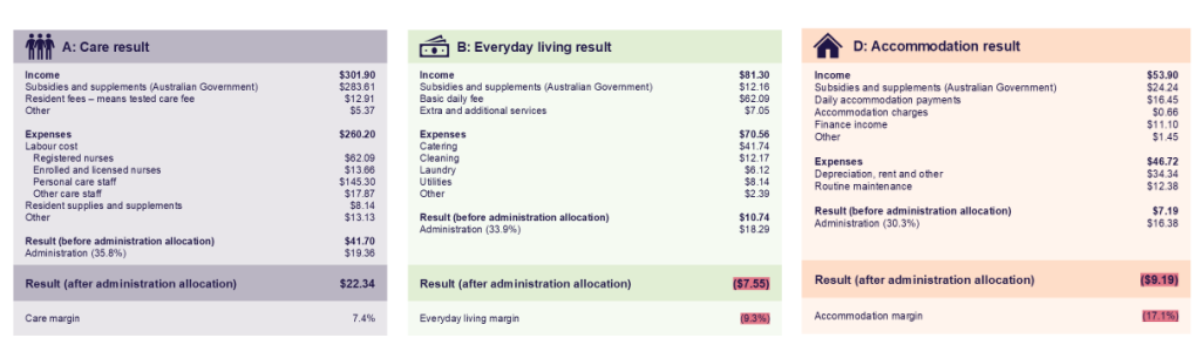
Continued cross-subsidising of care funding to cover losses
Continuing the trend of many years now, positive earnings for care (profit of $22.34 prpd) were offset by continued losses in everyday living (loss of $7.55 prpd) and accommodation (loss of $9.19 prpd) in 2024-25. This trend has also been highlighted in StewartBrown’s analysis.
In terms of care funding, across the four quarters of 2024-25, the proportion of services that met both their total care minutes and registered nurse minute targets, which operators are funded to deliver, ranged from 44.0% to 54.0%.
Together, these results indicate that providers are continuing to use care funding to cover losses in accommodation and everyday living.
In fact, the data shows aged care homes that did not meet their total care minutes targets in one or more quarters recorded higher care profits – indicating care minute non-compliance is an earnings driver.
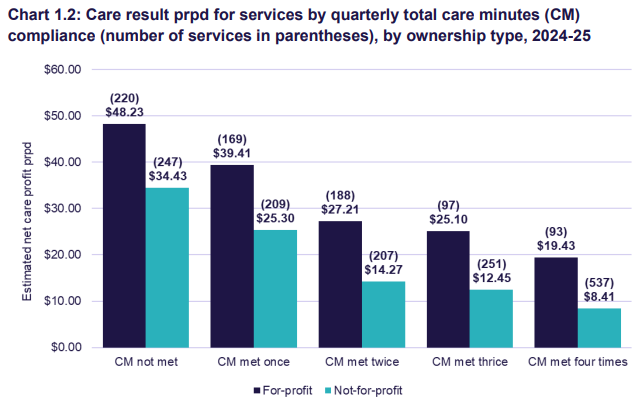
From 1 April 2026, the Government linked care funding to the delivery of mandated care minutes for non‑specialised, metro aged care homes (from care minutes starting October 2025). This reform is likely to drive higher levels of care minute target compliance this financial year.
Not For Profit providers delivered 3.22 average total care minutes prpd more than For Profit providers.
Other notable highlights of the report:
- The number of aged care residents rose 2.7% to 203,624 residents at of 30 June 2025, up from 198,362 residents on 30 June 2024
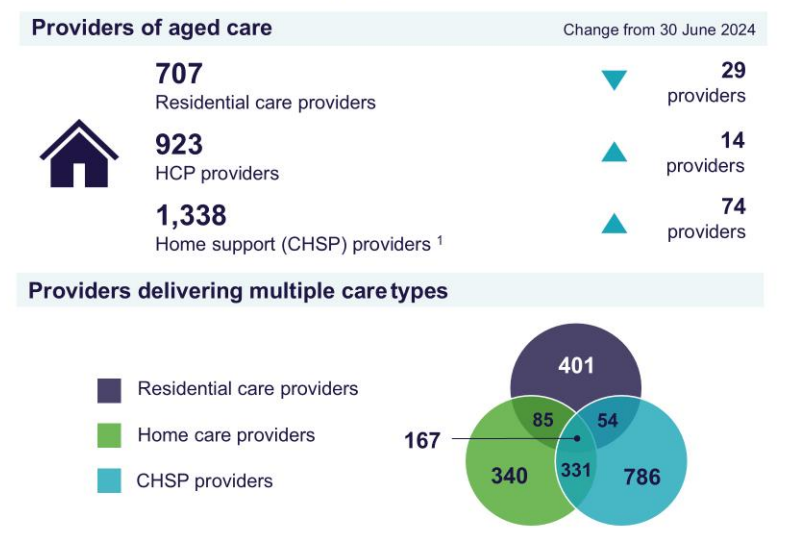
- Only seven operators entered the residential aged care sector, while 36 operators exited.
- The average occupancy rate across all residential aged care places was 89.9% in 2024-25, up from 88.0% in 2023-24.
- Total RADs/RACs held by providers increased to $48.4 billion at 30 June 2025 from $42.2 billion at 30 June 2024 .
See our separate article on the Government’s data on residential aged care capital works in 2024-25 here.


