
Minister Butler: StewartBrown reveals where aged care is failing


The accounting firm’s latest residential aged care survey shows earnings deteriorated in the first half of 2025-26 as increased funding fell short of higher labour costs.
The StewartBrown survey – which captures responses from 1,200 residential aged care homes, including 100,648 beds, representing 46% of the sector – shows residential aged care homes reported on average an operating deficit of $1.04 million for the six months to 31 December 2025.
The result is a significant deterioration on the $50,000 average surplus recorded for the six months to December 2024.
“The average financial performance remains at unsustainable levels for many providers,” states the 50-page Aged Care Financial Performance Survey Sector Report.
The result equates to a $9.80 per bed day (pbd) deficit for 1H FY26, compared with a $1.56 pbd surplus for 1H FY25.
As has been the consistent trend, surpluses recorded for direct care cross-subsidised losses for everyday living services and accommodation – but in 1H FY26, even direct care margins were significantly eroded.
The direct care margin for the six months to December 2025 was $6.15 pbd, a significant decline on the $19.08 pbd recorded for the previous corresponding period (pcp). The decline in the direct care margins reflects higher rates of direct care staffing, which cost more than the increase in AN-ACC funding intended to cover the cost.
StewartBrown’s latest survey came as Health and Aged Care Minister Mark Butler announced on Wednesday (22 April) that the Government would provide $3 billion to deliver 5,000 additional residential aged care beds per year.
On average, survey participants recorded 44.06 pbd RN care minutes and 221.68 pbd total direct care minutes for the December 2025 quarter, up from 41.23 RN minutes and 212.08 total direct care minutes for the December 2024 quarter.
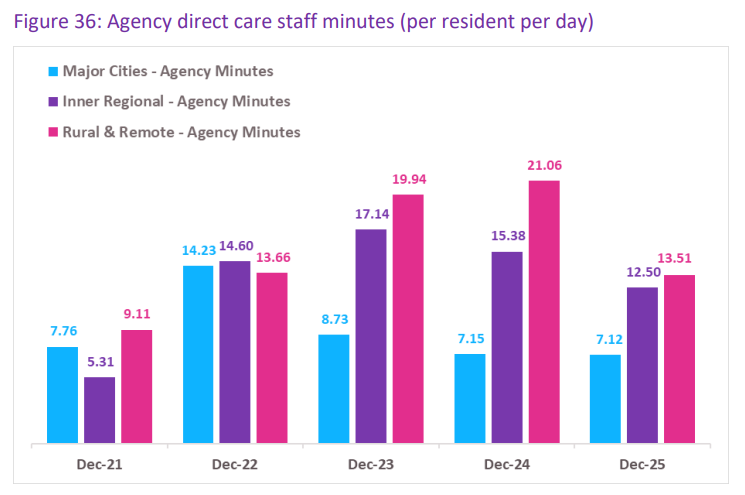
Direct care staffing increases came ahead of penalties for non-compliance with mandatory care minute targets for MMM1 homes, which took effect as of 1 April 2026, based on data for the December quarter.
The everyday living margin improved to a deficit of $2.66 pbd, up from a deficit of $6.33 pbd for the pcp.
However, the accommodation margin was a deficit of $13.30 pbd, a deterioration on the $11.19 pbd deficit recorded for the pcp.
Sector even less investable
Operating EBITDA averaged $4,582 per bed per annum (pbpa) for the six months to December 2025, roughly half the $8,310 pbpa recorded for the pcp – and a retreat from the $20,000-$22,000 pbpa operating EBITDA target StewartBrown has long advocated must be achieved for the sector to become investable.
Other key highlights from the report include:
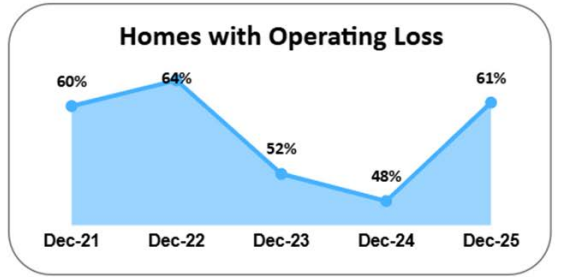
- 61% of aged care homes were operating at a loss during the first half – a return to levels seen at the height of the COVID-19 pandemic and in the immediate aftermath of the Aged Care Royal Commission – reflecting higher labour costs.
- Agency usage was 4.0% in 1H FY26, a slight decrease on the 4.8% recorded for the pcp.
- StewartBrown’s forecasts are “significantly worse” than previous forecasts due to the net impact of wage rises previously being understated and due to changes in AN-ACC classification structures.
- The report also notes the new Aged Care Act imposes “notable increases in administrative and reporting burdens”.
Positive returns be must achieved in all service areas of residential aged care, including direct care, for residential aged care to be investable, the report concluded.
StewartBrown will report the results of its Home Care data separately, and has delayed the release while it continues gathering data.


