
Home care wait times baked into Aged Care Rules


New Support at Home data showing wait times are falling should not raise sector hopes that delays receiving packages will reduce significantly in the short term.
Stephen Rooke, Director of consultants Pride Aged Living, said expectations that wait times will continue falling could be misplaced, according to their analysis, with wait times effectively baked into the legislation.
Sections 93-10 to 93-14 of the 712-page Aged Care Rules contain the mechanisms that control how new Packages flow to consumers.
A key component is the “target classification type wait time”, which is set by the System Governor (the Secretary of the Department of Health, Disability and Ageing or their delegate) “from time to time”. This is based on the Government achieving its three-month target wait time for Support at Home packages by 1 November 2027.
This target wait time feeds into formulas that determine how quickly Support at Home packages at each classification level (1-8) and priority (urgent, high, medium, standard) flow to consumers, a factor that is calculated daily.
The examples below demonstrate how the Government-set target wait time – “T” – impacts how long consumers wait to receive packages.
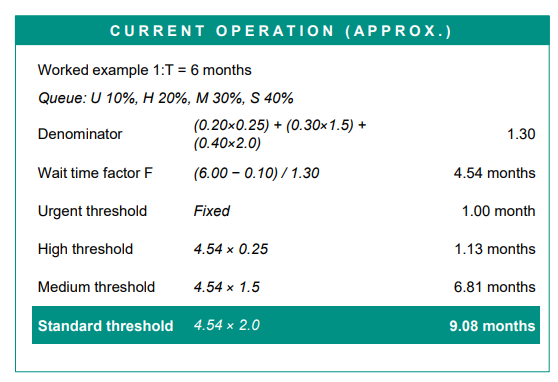
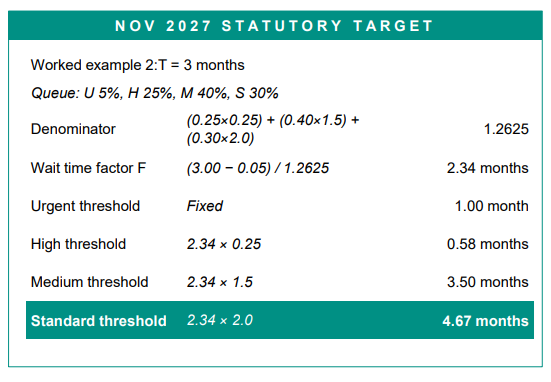
Pride Aged Living says the Government could be using alternative levers to achieve the three-month target without additional investment.
For example, last November around 95% of Support at Home packages were released as Interim packages at only 60% of funding. Consumers are staying on these packages for up to 17 weeks in some cases. In addition, operators say the Integrated Assessment Tool (IAT) is systematically under-identifying need.
Stephen told The Weekly SOURCE that there should be more transparency about how long providers and consumers will have to wait for home care and how decisions about wait times are made.
“Some element of a queue is a fact of life under the new Act,” he said.
“The formula doesn’t respond to urgency in the way people expect, which requires individuals and providers to approach the system with a plan.
“Every month spent in the queue before commencement is a month that counts, and the earlier a person applies, the earlier that clock starts.”
Data released this week shows Support at Home wait times are out to eight months, yet Department officials at Senate Estimates say the system is on track to achieve the three-month goal by November 2027. With only 17 months to go, watch this space.


