
MPIR hits 14-year high: what it means for aged care operators


- MPIR rises: Highest level since 2012 reaches 8.43%
- Earnings impact: Higher DAP revenue modestly lifts provider margins
- Resident choice: RAD retention may outweigh higher DAP costs
- 2027 reforms: Government replacing MPIR conversion methodology
The Maximum Permissible Interest Rate (MPIR) has reached its highest level in 14 years, reshaping how aged care providers can charge for accommodation.
Retired StewartBrown Partner Grant Corderoy says the MPIR’s increase to 8.43% in the September 2026 quarter – its highest level since 2012 – may give residential aged care operators a small fillip to earnings, but not enough to materially improve financial sustainability.
“If we assume a resident turnover of 2.9 years, the financial effect based on the current average full RAD [Refundable Accommodation Deposit] received of $563,000 would increase the annual DAP [Daily Accommodation Payment] revenue for residential aged care homes by $68,400 per annum (based on an the sector average of 84 beds per home),” he told The Weekly SOURCE.
“This would eventually (after full resident turnover) increase the overall operating result by $2.35 per bed day.”
RAD retention will erode preference for DAPs
The Independent Review of Residential Aged Care Accommodation Pricing, published in May, noted that changes in the MPIR influenced resident choice between a RAD and a DAP.
When the MPIR is low, the cost of paying a DAP is lower and more residents chose this option – see the chart below.
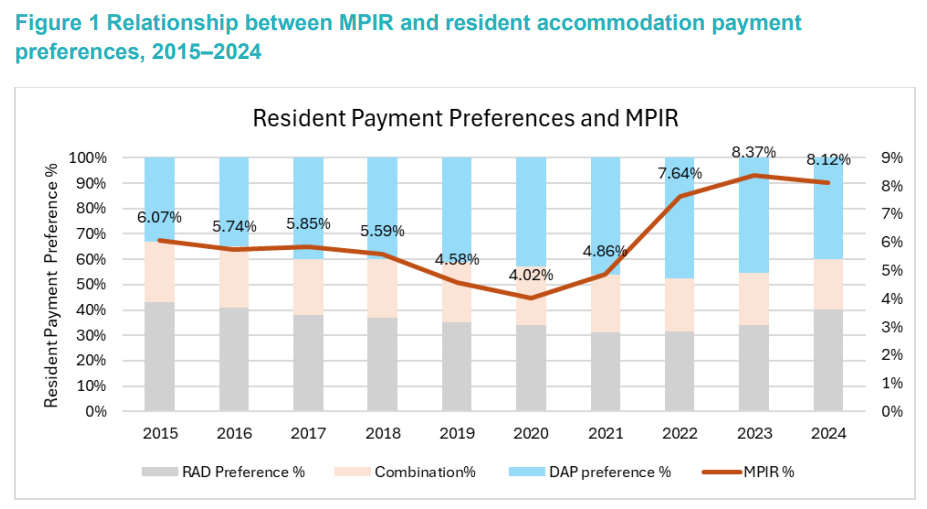
For non-supported residents, using the period from COVID-19 as reference, when the MPIR was 4.01% moving to 5.0%, full RADs received only increased slightly from 39% up to 40%, Grant pointed out.
Since that period, full RADs received have increased to around 50% of preferences as the MPIR progressively rose to 8.43% in the September 2026 quarter.
However, RAD retention will offset some of the advantage of paying a DAP.
“The RAD retention of 2% pa for five years together with the indexing of the DAP for new residents will likely offset the effect of the MPIR increasing to 8.43% for the September 2026 quarter (0.47% uplift) and accordingly should not have a major effect on resident choice,” said Grant.
What is the MPIR?
The MPIR is the interest rate set by the Australian Government that residential aged care operators use to convert between a RAD and DAP. The MPIR rate is set quarterly, and the new rate only applies to incoming residents for the respective quarter.
The MPIR is determined by the Department of Health, Disability and Ageing using a formula linked to the 90-day average yield on Australian Government 10-year Treasury bonds, plus a margin specified in legislation.
The Independent Review of Residential Aged Care Accommodation Pricing recommended the MPIR be replaced with a new methodology.
“The recent federal budget stated that from 1 July 2027, the MPIR will be replaced with a new method for converting daily accommodation payments into refundable deposits,” Grant said.
However, the Government has yet to announce a new formula.
Move to rental income
StewartBrown has long advocated for a move away from setting accommodation prices based RADs calculated using the MPIR. The accounting firm has pushed for a daily rental payment as an alternative, based on targeted returns.
Such a reform would boost revenue and increased investor confidence in the residential aged care sector, Grant added.


