
$3 billion shows the Government is listening – now for productivity


For weeks, the expectation in aged care was simple: there is no new money coming – then $3 billion landed.
In one move, the Federal Government acknowledged aged care is under extreme supply pressure.
Yesterday’s announcement by the Health and Aged Care Minister Mark Butler, alongside the release of the Accommodation Review, delivered $3 billion in new funding to a strategy laid out in that Accommodation Review, in particular:
1. Establish a zero-interest loan scheme for new builds, significant expansions and refurbishments, to finance capital investment on behalf of supported residents.
2. Introduce two new capital subsidies, for supported residents housed in newly built or significantly expanded or refurbished homes.
The Review states Australia needs around 10,600 new places a year – the Government’s starting point is to stimulate the delivery of 5,000 new beds per year, about 50 new facilities annually.
It is a start, and it is $3 billion more than the sector was expecting, at a time where the Government and the country is facing its most challenging economic time since 1976.
So we give some credit to the Government. It is a start.
More importantly, it is a recognition of the challenge of a 75% increase in the number of people turning 82 (average entry age to Support at Home) over the next two years that will require aged care services, not to mention the huge wave of dementia coming our way. (Minister Butler did allocate $200 million for 20 new Specialist Dementia Care units, again a start).
How will we deliver for these numbers of new clients? The only fast way to free resources and generate cash short term is productivity gains in the existing system.
Imagine if the sector’s Plan T initiative can identify 20% savings of not only money but physical hours; it would release $4 billion to spread across Support at Home, making it viable, and residential care.
For RAC operators, their $4 billion is the equivalent of $55 a day for every existing aged care bed, making the sector investible overnight, which would then deliver the 10,000 new beds a year that the country requires.
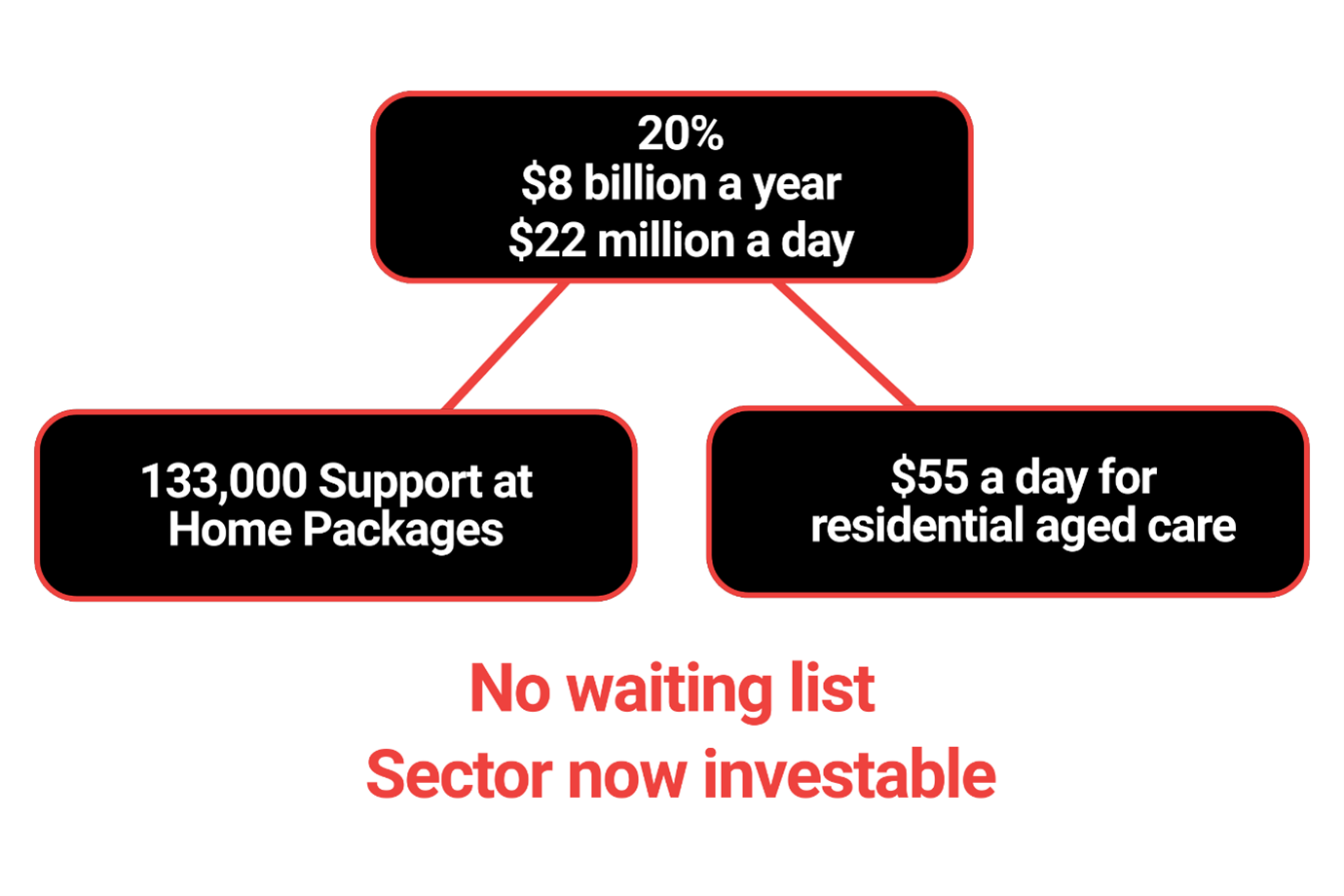
So thanks Minister Rae and Minister Butler for the cash we were not expecting. Let’s now combine forces and make it a priority to find 20% productivity gains.
In our view, it is the only hope on the horizon, and it is achievable.


