
Aged care doesn’t have a workforce problem – it has a productivity problem


The sector has spent years focused on finding more workers. But what if the bigger opportunity lies in helping existing staff spend less time on administration and more time delivering care?
The aged care sector spends enormous amounts of time talking about workforce shortages for good reason.
Every provider is recruiting. Workforce forecasts suggest demand for care will continue to outstrip the number of people available to deliver it.
But what if the bigger problem isn’t the number of workers?
What if it’s the amount of time skilled workers spend doing things that have little to do with care
That question sat at the centre of a recent DCM Group webinar featuring Tate Johnson, Chief Technology Officer at digital home care management The Lookout Way, Jennene Buckley, Founding Partner at specialist home care consultancy Enkindle Consulting, and John Staines, Chief Information Officer at aged care provider Benetas.
While the discussion focused on artificial intelligence, it quickly moved to a much bigger issue: productivity.
Productivity’s hidden drain
Tate believes the sector is approaching a point where simply adding more people won’t be enough.
“The opportunity is to completely reimagine how you should be delivering services,” he said.
He argues that artificial intelligence isn’t really about technology – it’s about redesigning work.
Over the past five years, providers have had to respond to growing regulatory, compliance and reporting requirements. Few would argue those expectations are unreasonable, but every new requirement adds another layer of work around care delivery.
“The biggest problem in orchestration is the communication and sharing of information,” Tate said.
That might mean information being entered multiple times, staff searching for documents, manually coordinating services or moving data between systems that don’t communicate with each other.
Individually, those tasks don’t seem significant, but across an organisation they can consume hundreds of hours every week.
Quality versus burnout
Care managers are expected to maintain quality, meet compliance obligations, support staff and keep services running, often while dealing with increasing volumes of information and administration.
Historically, providers have accepted that maintaining quality comes with a workload cost.
Tate believes that equation is beginning to change.
“I think the thing that I’m most excited about is you don’t have to choose between those two things,” he said.
“You don’t have to choose between quality and burnout anymore.”
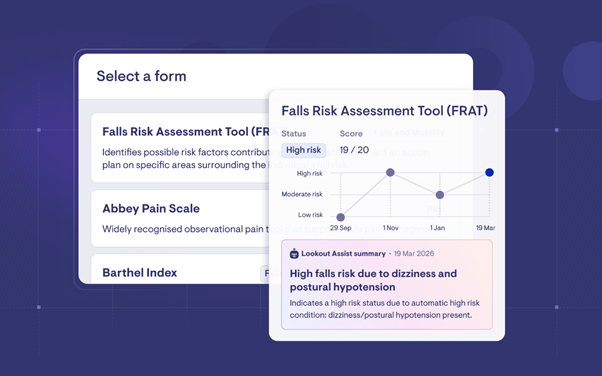
Care planning is one example. Creating and reviewing care plans requires staff to pull together information from multiple sources, assess risks, document decisions and ensure everything aligns with organisational requirements. The professional judgement remains essential; much of the administration surrounding it may not be.
“All the chores in those roles should be done by AI,” Tate said.
The goal isn’t to replace expertise. It’s to allow experienced people to spend less time gathering information and more time applying their knowledge.
The boardroom blind spot
Jennene says many providers are still underestimating the role technology plays in organisational performance.
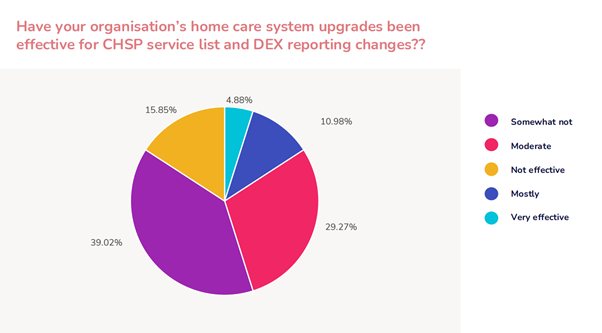
Her latest Home Care Outlook Survey (pictured below) found 64% of providers say their technology systems are either not meeting their needs or are effectively non-existent – a figure that has barely shifted in four years.
She told the audience that technology should be viewed in much the same way organisations think about physical infrastructure.
“Your technology is the bricks and mortar of your organisation,” she said.
“So when we think of residential care, traditionally it was the big buildings and they had the big plans on the wall. Boards need to have their IT plan on the wall.”

Before investing in artificial intelligence, Jennene believes providers need to understand where time is actually being lost.
“We need to know what the problem is and quantify it,” she said.
“Just ask staff: what are the 10 things you’re wasting your time on?”
From paperwork to care
The impact of those inefficiencies is already becoming visible across the sector.
Benetas delivers between 700 and 1,000 care activities every day, generating around 1,000 care notes.
Reviewing that volume of information manually is becoming increasingly unrealistic.
Chief Information Officer John Staines said the workforce response to AI-enabled tools had been overwhelmingly positive.

“The workforce is extremely energised with the results because those frustrations have eased,” he said.
For a sector searching desperately for more workers, the bigger opportunity may be helping existing staff spend more time doing what they entered the sector to do in the first place: care.


