
Department blames providers for home care statement problems


Support at Home statement issues persist
- Monthly statement issues continue: Providers struggling to produce mandatory statements
- Services Australia reconciliation challenges: Providers say system is complex
- Administrative burden growing: Workarounds and customer support requirements
- Support at Home profitability questioned: Data suggests earnings may be lower
The Department has blamed provider software for ongoing problems with Support at Home monthly statements, but operators argue the Government’s own systems may also be at fault.
More than six months after Support at Home was implemented, providers are still experiencing problems issuing a core document.
Monthly statements are a mandatory document showing total Government funding available to customers for the previous month, participant contributions, services provided, care management, prices for each service, unused funding, and a closing balance.
The documents regularly run up to a dozen pages, often more.
This week, the Department of Health, Disability and Ageing’s weekly Your Aged Care Update email said providers are “experiencing issues“ generating monthly statements “due to their own software or the software vendor they use”.
They recommended providers must resolve the issue “as soon as possible” and “use other ways to give your participants information about how their budget is being spent”.
“The Commission may take regulatory action if you’re not meeting your requirement to issue monthly statements,” the update said.
Yvonne Timson, CEO of WA home care provider Community Vision, told The Weekly SOURCE they are experiencing problems issuing monthly statements and have resorted to workarounds.
However, the problems are not related to their or vendor software, but to the design of Support at Home and trouble reconciling figures with Services Australia.
In particular, reconciling the 10% monthly rollover amounts with Services Australia has been difficult to achieve consistency, Yvonne said.
Credit notes have also proved hugely complex because of the requirement to separate each note into a different funding pocket, involving “multiple sections upon multiple sections”.

Workarounds are increasing Community Vision’s “administrative burden significantly”, said Yvonne, adding that staff are also taking additional time to explain statements to customers due to their complexity.
Yvonne said the Department is “quick to push it back on providers”.
Instead, she would like to see the Department acknowledge the complexity and that some of the issues relate to ensuring data is “acquitted” correctly with Services Australia.
“If we can’t align with that, then we can’t report it to the customer,” she pointed out.
If the administrative burden continues long term, Community Vision’s sustainability could be threatened.
“Long term sustainability is front of mind for my board consistently,” Yvonne said.
“With all of the increases in business costs, the increase in administration, the increase in salary and wages, which the staff absolutely deserve, it’s how will we fund that ongoing?” she said.
The problems are not isolated to the monthly statements, but more broadly to the design of Support at Home.
Last month, StewartBrown warned there are “early signs” that Support at Home is less profitable than the former Home Care Packages program, with data for the first two months of the program showing eroded earnings. See below.
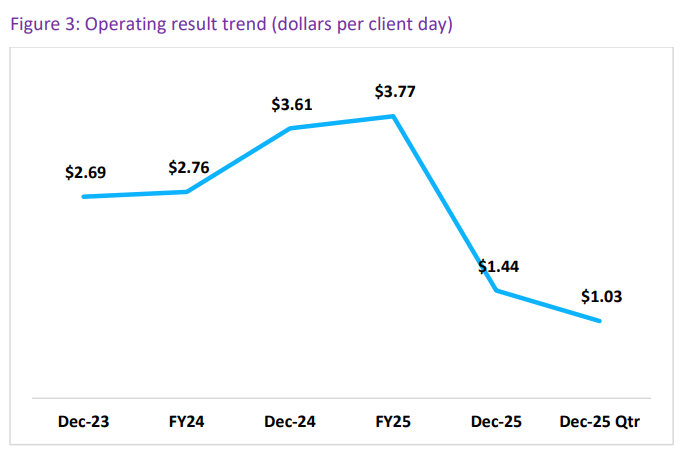
“I think it’s really important for the government to have a look at the StewartBrown data that is being released and what that is saying,” Yvonne said.


