
Home care operators tell Minister: no “price gouging”


Support at Home pricing pressures hit providers
- Prices rise modestly: Support at Home prices up by just over 10% on average
- Margin pressure: Providers say rising costs forcing operators to consider exiting home care
- Consumer confusion: Operators say clients are struggling to understand Support at Home
- Caps delayed: The Government has indefinitely postponed Support at Home price caps
December Support at Home pricing data shows home care prices were only modestly higher than indicative prices published last October - yet operators are being forced to defend themselves.
Last Tuesday (19 May), the Government hit pause on its plan to roll out prices caps for Support at Home services – just six weeks out from their 1 July implementation date.
But the welcome move was accompanied by claims of “price gouging” by the Federal Health and Aged Care Minister Mark Butler.
This is despite recent data from November-December 2026 showing Support at Home prices have risen on average around just over 10% from indicative Support at Home prices published in October 2025. See below.
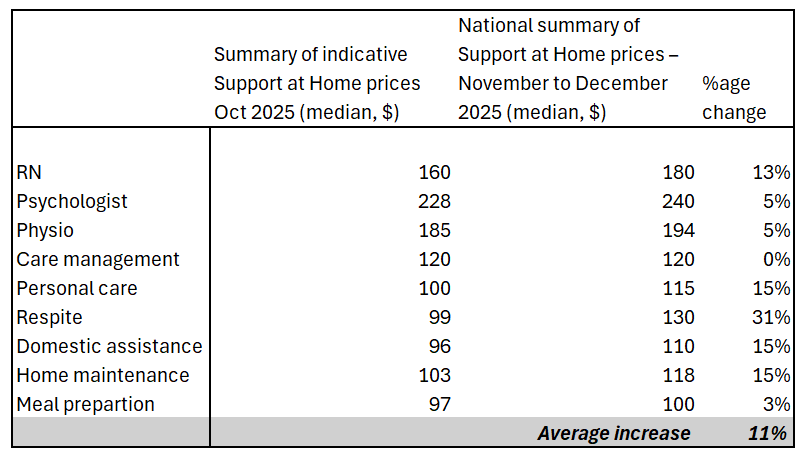
Support at Home prices were always going to be higher than Home Care Package prices. StewartBrown’s modelling had shown that Support at Home prices needed to climb by 30% to hold the same margins under the previous Home Care Packages program, and by up to 38% to achieve the 9.5% margin required to make the sector investable.
Now operators have rejected the Minister’s comments, warning that many operators may choose to exit the sector if they cannot be sustainable.
Operators considering home care exit
Sarah Newman, Chief Operations Officer – Home Care at BaptistCare, among Australia’s 10 largest home care providers, said higher prices under Support at Home are justified on the whole.
“While there may be a few outliers who are pricing above reasonable levels, generally we are seeing providers who misjudged the impact of the changes – and set their pricing too low – are now finding themselves in difficult financial positions,” she said.
Margins are contracting under Support at Home, she said, a view that correlates with StewartBrown’s recent 1H FY26 home care report.
“The Support at Home model is expensive to deliver,” Sarah said. “Most providers are seeing margins under pressure, and we are already noting a number of small and mid-sized organisations seeking to exit the sector,” she said.
David Cox, Managing Director of Curtin Heritage Living, said Butler’s comments add to the mistrust that Support at Home has introduced to the sector. The label is unfair, he said.
Consumer contributions confusing consumers
Curtin Heritage Living has seen package utilisation “far lower” under Support at Home. This trend was also identified in StewartBrown’s recent report.
“Clients are confused by the Support at Home arrangements and reluctant to pick up services, even when those services will ultimately keep them at home,” David said.
“Support at Home is more complex, harder to manage, and harder to explain to consumers.”
David said margins may improve when personal care becomes fully funded by the Government from October 2026.
Both David and Sarah also see the complexity of Support at Home as a key problem. David would like to see Support at Home simplified so the cost of administration can be reduced.
BaptistCare wants the Care Management fee increased to at least 15% and the reintroduction of a fixed charge “to cover the complex administration burden of the program”.


