
StewartBrown sounds alarm on aged care margins


- Investment gap: Returns well below the level needed to attract capital
- Financial pressure: Nearly two-thirds of aged care homes report losses
- Care squeezed: Direct care margins have narrowed
- Occupancy rising: Not enough to restore profitability
Residential aged care margins have fallen off a cliff despite providers gaining access to new revenue streams under the new Aged Care Act.
Direct care margins remain under pressure while accommodation and everyday living services continue to operate at a loss, according to StewartBrown’s latest Residential Aged Care Financial Performance Survey covering the period 1 July 2025 to 31 March 2026.
The survey found 62% of residential aged care homes operated at an operating loss during the nine-month period, up from 49% in March 2025, despite providers benefiting from reforms introduced under the new Aged Care Act since November 2025.
Those reforms included new accommodation revenue opportunities, such as the introduction of a 2% Refundable Accommodation Deposit (RAD) retention payment for new residents, Higher Everyday Living Fees (HELF) and revised resident contribution arrangements.
However, StewartBrown noted many of those reforms remain in the early stages of implementation and will take time to reach financial maturity because of grandfathering arrangements and the gradual transition of residents to the new funding settings.
Warning becomes reality
StewartBrown had previously warned that direct care margins would come under pressure as providers delivered higher care minutes. Its latest survey suggests those workforce costs continue to outpace funding increases.
According to the survey of 1,173 residential aged care homes, representing around 45% of the sector, returns remain well short of what is required to attract the capital needed to build enough new aged care beds for Australia’s rapidly ageing population.
The average operating result was a deficit of $9.16 per bed day for the nine months to 31 March 2026, a significant decline on the $0.91 per bed day surplus recorded for the same period in 2025.
Operating EBITDA averaged $4,835 per bed per annum, nearly half the $8,067 recorded for the previous corresponding period.
StewartBrown said the result remains significantly below the $20,000 to $22,000 per bed per annum operating EBITDA it believes is required to drive investment in new residential aged care developments.
Margins sitting at 1%
The year-to-date result gives an implied return on capital of approximately 1% per annum, based on an assumed replacement cost of $500,000 per bed.
Again, the result is well below the 4% to 4.4% return on capital StewartBrown says is required for residential aged care to become an investable sector.
The increase in loss-making homes returns the sector to financial performance levels last experienced around the time the Australian National Aged Care Classification (AN-ACC) funding model was introduced three years ago.
Care margins continue to tighten
Historically, StewartBrown’s residential aged care survey has shown margins from direct care have been used to subsidise losses in accommodation and everyday living.
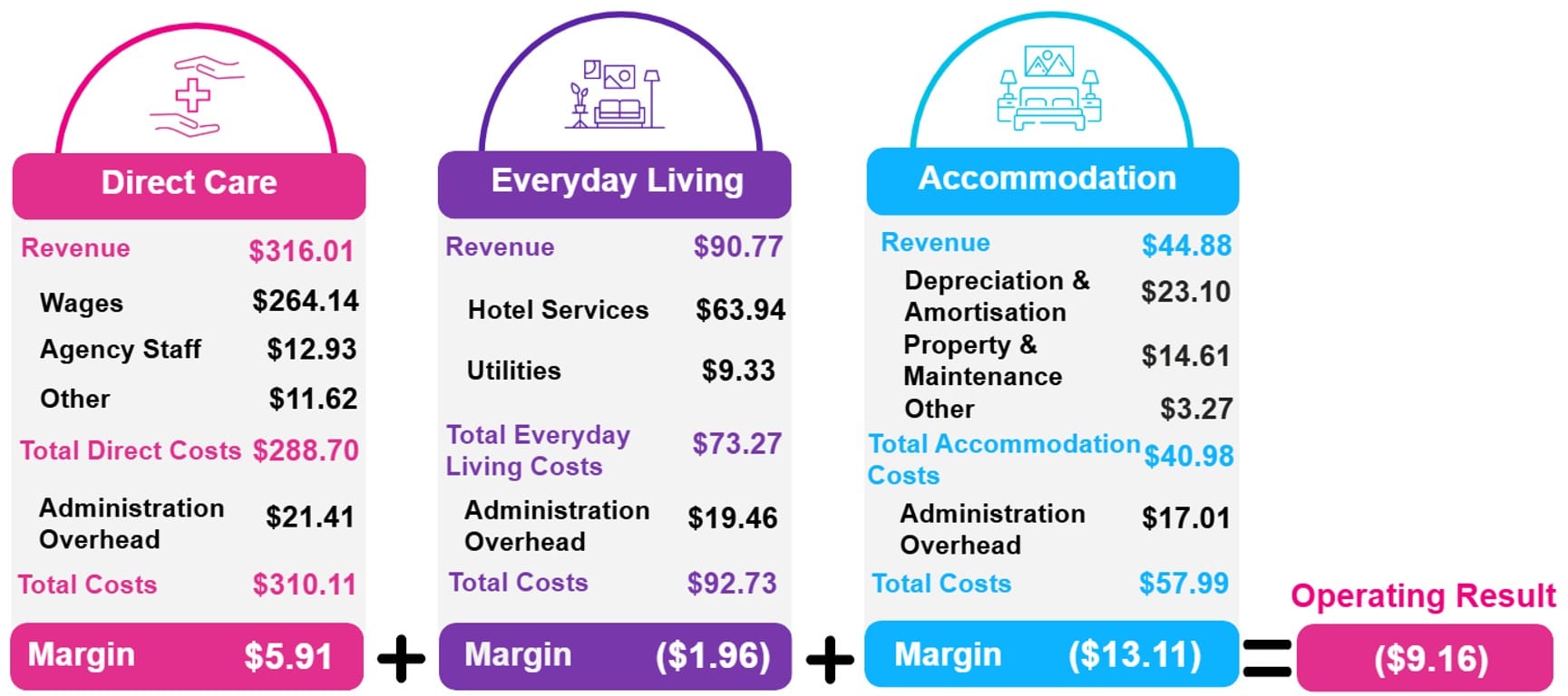
However, direct care margins continue to come under pressure as providers deliver higher care minutes – see the image above.
Direct care revenue increased 6.61% over the year, while direct care costs increased 11.66%, reflecting continued wage growth and staffing costs.
The direct care margin fell from $18.46 per bed day in March 2025 to $5.91 per bed day in March 2026.
Accommodation reforms yet to deliver
The sector also continues to make substantial losses through the delivery of accommodation and everyday living services.
The everyday living margin improved to a deficit of $1.96 per bed day, compared with a $6.60 deficit a year earlier.
However, the accommodation deficit widened from $10.95 per bed day to $13.11 per bed day.
In addition, occupancy increased to 95.2% for the nine months to March 2026, up from 94.2% the previous year.
StewartBrown forecasts the sector will stay at close to full occupancy for at least the next five years and beyond.
Despite that demand, it says stronger financial returns are needed to improve the sector’s investability and ensure future supply.
Note: StewartBrown’s home care financial survey will be reported separately as it continues to capture data under the new Support at Home program.
StewartBrown’s Residential Survey Report is available here.


