
States reject Butler’s aged care bed shortage claim


Planning reform under spotlight for aged care
- Bed shortages: planning delays blamed for slow growth
- Minister warning: aged care demand outpaces approvals
- State reforms: faster pathways introduced for developments
- Construction challenge: new beds still lag demand
Close observers of Federal Health, Disability and Ageing Minister Mark Butler’s media appearances may have noticed a recurring theme emerging in recent weeks.
Under pressure to explain the shortage of aged care beds preventing 3,300 older people being discharged from hospital, the Minister has repeatedly said state planning rules and local council governments are slowing down construction of new beds.
Last Wednesday (10 June), Butler said: “We have to get planning approval for all these facilities ... Otherwise, older Australians increasingly are going to find it hard to get the care and support that they deserve from a country they built.”
The following day (11 June), the Minister reiterated: “I want to be honest that we can’t magic up the number of aged care facilities that we need next week, the week after that, the week after that, without all levels of government, including local government, putting their shoulder to the wheel, recognising we’ve got a huge job ahead of us to make sure we have the facilities that we need.”
Butler singled out the Illawarra region as having particular problems getting aged care beds approved by the local council.
“We’ve granted hundreds of beds into that region but not been able to get planning approval from the Wollongong City Council because they object to the height that we're going to have to build these new facilities at,” he said.
State Government planning departments have told The Weekly SOURCE they have implemented new policies to assist with the construction of new aged care beds, yet the low levels of construction last financial year suggest the reforms have borne little fruit.
The debate follows months of debate between Federal and State Governments over Federal funding of State-run hospitals, resulting in an additional $25 billion for the States over five years.
Western Australia’s new land use types
Western Australia introduced a Position Statement in response to the State’s ageing population to ensure local government's planning frameworks provide for aged care accommodation.
“We know we have an ageing and growing population and that’s why we’re focused on boosting the supply of seniors’ accommodation and aged care beds,” a spokesperson for the Western Australian Government told The Weekly SOURCE.
"Modelling shows that WA will need approximately between 1,600 to 2,700 new residential aged care beds by the end of 2030."
The WA Government has also approved the sale of Crown land to the Shire of West Arthur at a 72% discount to allow for the delivery of new aged care housing in Darkan, 200km south of Perth.
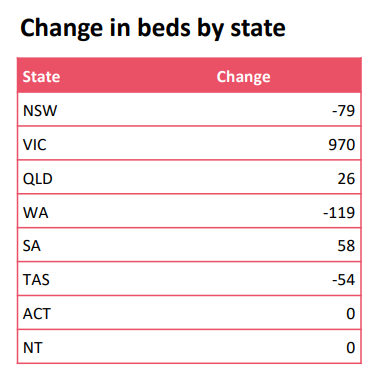
The spokesperson said three new aged care homes were built in 2025, however Bolton Clarke analysis shows the number of aged care beds in WA declined by 119 in 2024-25 reflecting bed and home closures.
South Australia recognises aged care as essential infrastructure
South Australia introduced a series of planning reforms late last year to help address the national shortage of aged care beds, a spokesperson for SA’s Department for Housing and Urban Development told The Weekly SOURCE.
The reforms include a new planning overlay allowing aged care buildings to be taller – up to four storeys on sites between 6,500 square metres and one hectare, and up to six storeys on sites larger than one hectare.
Aged care developments sponsored by the State Government are also able to be recognised as ‘essential infrastructure’, under the authority of the Minister for Planning.
Essential infrastructure is a streamlined, fast-track approval process usually reserved for electricity and water generation and supply, transport networks, health, education, police, justice, emergency services – and now residential aged care facilities.
In December last year, South Australia’s independent planning body approved a new 156-bed aged care facility in Parkside, close to central Adelaide. The five-storey residential aged care facility will be built and operated by Regis Aged Care. Until recently, most large-scale aged care developments in South Australia were assessed by local councils.
South Australia added only 58 aged care beds in 2024-25, Bolton Clarke’s analysis shows.


