
“Much more can be done” to ensure aged care residents’ safety


- Coroner acts: National medication standards urged
- Three deaths: Medication errors prove fatal
- Safety gaps: Emergency responses under scrutiny
- Lives at risk: Can reform wait?
Residential aged care residents remain at “risk of harm” unless national medication safety standards are introduced, a Victorian coroner has found.
The Coroner’s recommendation comes after three Victorian aged care residents, Rosemary Jacoby (94), LV (78), and Lynette McHarry (69), died in 2024 and 2025 after being mistakenly given other residents’ medication.
Coroner Ingrid Giles identified the incidents as a cluster, saying the cases highlight that “much more can, and should, be done” to ensure the safety of “highly vulnerable” members of the community.
The Coroner also noted that in two out of three of the cases investigated, staff delayed escalating the incident to ‘000’ when time was extremely crucial.
The Coroner had referred the case to the Coroner’s Prevention Unit (CPU), which found there were six medication error-related deaths of aged care residents in Victoria between 21 October 2021 and October 2025.
The CPU’s findings led Coroner Giles to make further inquiries.
In response to her queries, the Aged Care Quality and Safety Commission revealed there are no national medication safety standards for residential aged care facilities.
Cases “horrific”
The Coroner also consulted with the Inspector-General of Aged Care Natalie Siegel-Brown, who told Coroner Giles the cases were “horrific”, noting there are “gaps and major concerns” in the regulation of medication management in residential aged care.
The Inspector-General’s 2025 Progress Report on the Implementation of the Recommendations of the Royal Commission into Aged Care Quality and Safety also noted recent reforms do not fully addresses the Royal Commission’s concerns related to medication management.
Only RNs can administer medication in Victoria
The Victorian Government has taken some steps to improve medication safety for aged care residents in the state, mandating that from 1 July 2026, only Registered Nurses can administer prescribed and regulated medications in aged care homes.
However, the Coroner said: “Medication misadministration in aged care facilities is a broader issue that requires urgent reform.”
Specific safety standards required
“Residential aged care facilities are in urgent need of clearer medication safety standards that are specific to the unique environment staff are operating in,” she said.
She recommended the Department of Health, Disability and Ageing “urgently progress” the development of national safety standards for medication management in residential aged care and clear standards for post-error emergency and reporting responses.
A longstanding issue
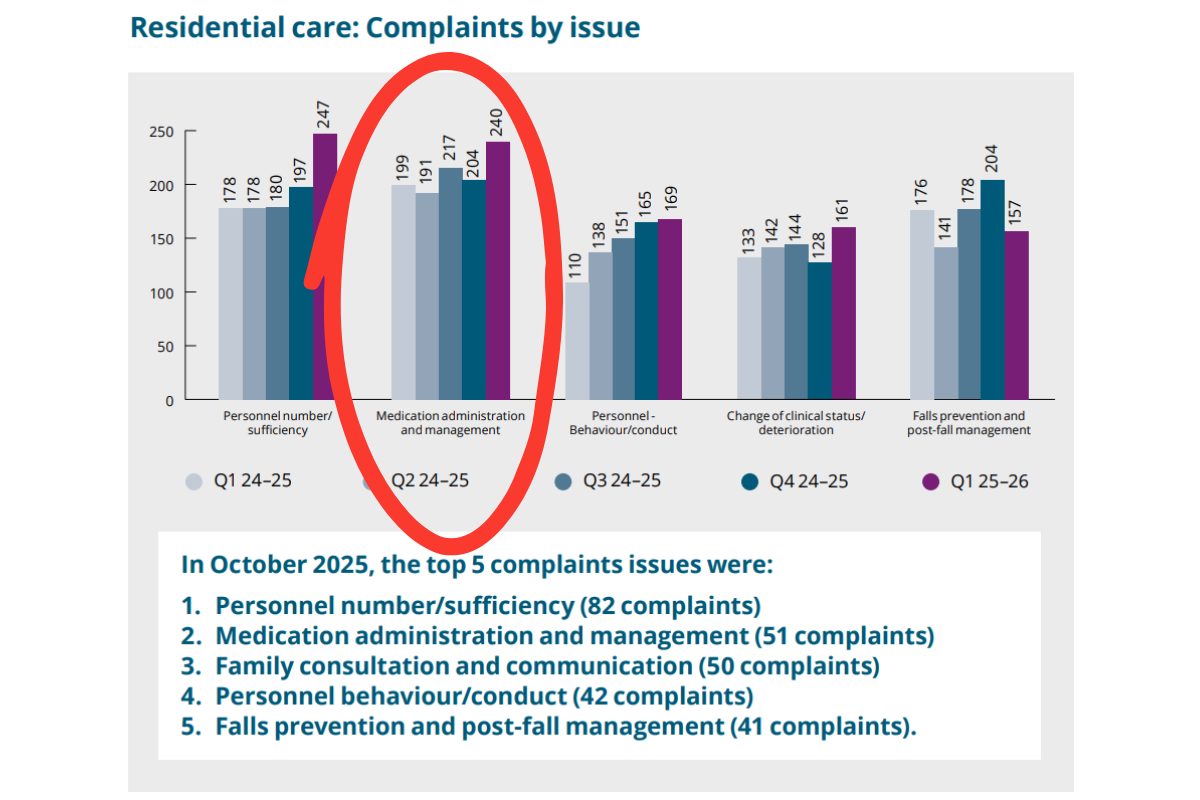
Medication management has long been one of the top two most-complained-about issues in residential aged care – see historical data above.
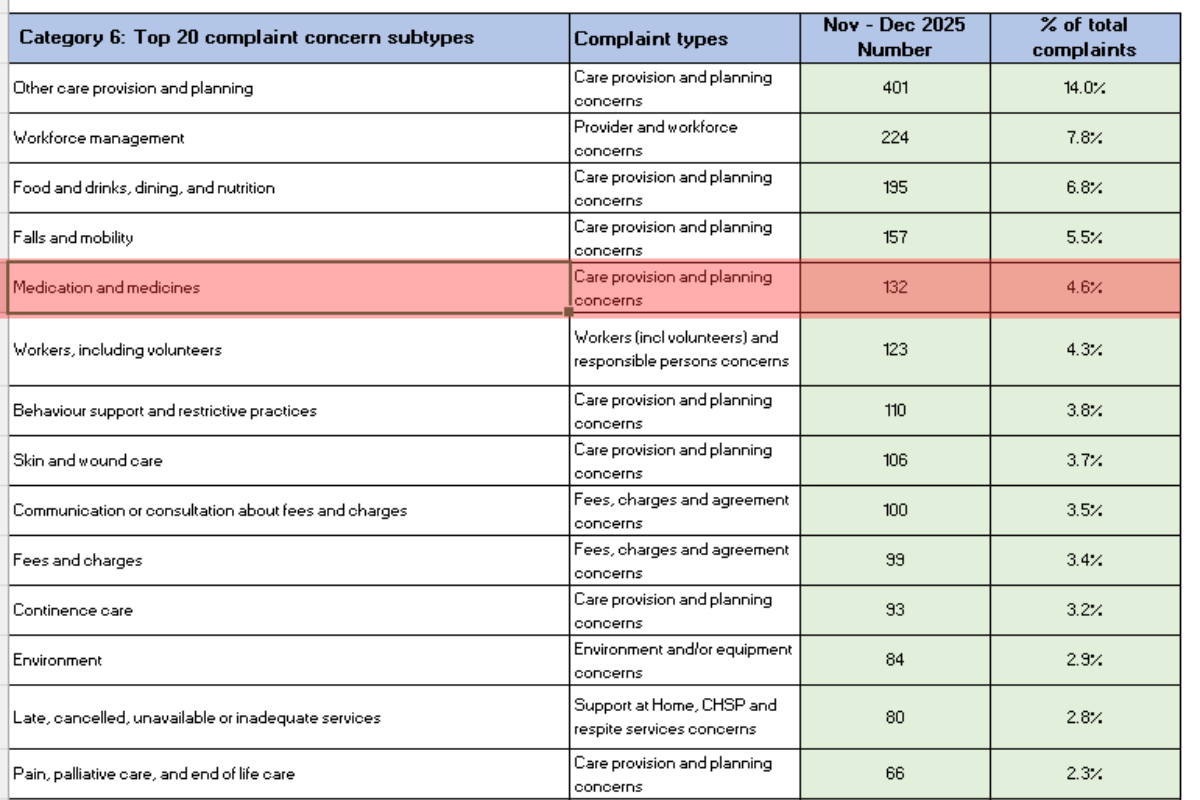
New data published since the new Aged Care Act took effect shows a lower number of complaints but only reflects a two-month period.
The Department did publish Guiding Principles for Medication Management in Residential Aged Care Facilities in 2022.
The question now is whether they should be strengthened into mandatory standards.


