
“Timely opportunity” for village operators: new StewartBrown Retirement Living report


The newly released FY25 StewartBrown Retirement Living Performance Report confirms there has never been a stronger time to grow your business.
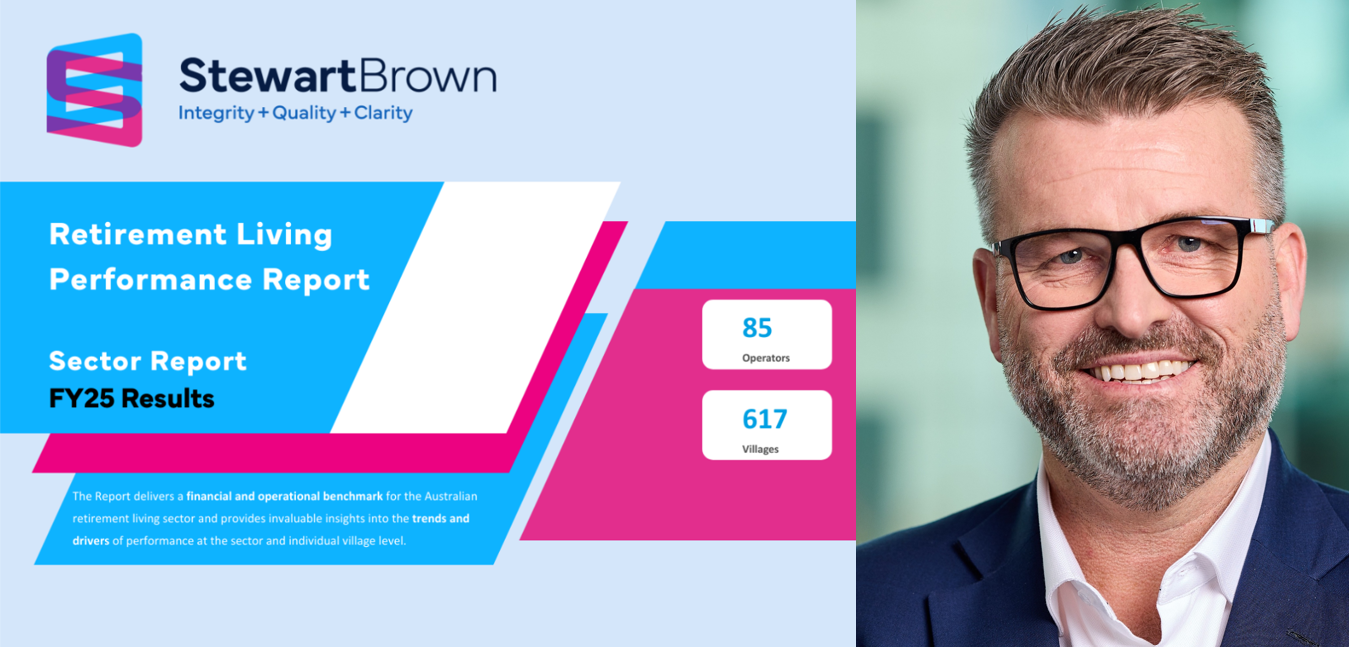
To simply maintain current penetration rates, the sector needs to deliver 51,000 additional units by 2030, states the Report, which surveyed 85 operators, 617 retirement villages, and 43,628 units.
However, with occupancy rising to 91% (up from 88.8% last year), there is little capacity left. More development has to occur.
“Without a material increase in the number of units constructed, the penetration rate for Australians over 75 in retirement living will inevitably decline,” said StewartBrown Partner Stuart Hutcheon.
Australia’s population aged 75 and over is forecast to grow by 20% over the next five years, yet projected unit supply from report participants is expected to rise by only 16%.
Unique opportunity
Stuart continued: “Baby Boomers have begun transitioning into retirement communities. With home ownership rates around 80%, the Baby Boomer generation represents a demographic in a better financial position than other cohorts to afford the current upfront price to enter a retirement village.
“This creates a timely opportunity for operators to upgrade and expand retirement
living building stock while home ownership and property values remain high.
“In contrast, home ownership rates among subsequent generations are declining.
Younger cohorts are purchasing homes later in life, reducing the length of time
available to build equity, compared with previous generations. This may be
somewhat offset by intergenerational wealth transfer.
“Looking ahead 20 to 30 years, these cohorts are increasingly expected to include a
higher proportion of long‑term renters, relying more heavily on superannuation
balances rather than housing equity to finance their entry into retirement living.”
The new report also reveals:
- Average age of incoming residents into retirement villages is 78.3 years (FY24: 78.4 years);
- Average length of occupancy for existing residents is 7.2 years (FY24: 7.4 years);
- Average length of stay for departed residents has increased to 8.8 years (FY24: 8.2 years).
- Age profile analysis shows 77.8% of residents are over 75 years, with 32.1% of residents aged over 85 years.
“This ageing profile is fundamentally reshaping village operations, and the services residents expect,” Stuart said.
“Care, wellness, accessibility, and community engagement are no longer ‘nice-to-have’ – but are now becoming essential components of a modern village offering.”


